The question
I think the answer is simple: a world where we can do anything we want.
That takes two things people usually treat as opposites, freedom and safety. I think they’re twins. You can’t be free to choose your work if one bad month can cost you your home.
Why now
Machines are learning to do almost any job. The AI industry has spent years pitching capability and checks: AGI, intelligence explosions, dividends. It has rarely said what changes for you, and people have noticed. Half of Americans now say AI makes them more concerned than excited.
Meanwhile, economists at universities and AI labs agree on at least one thing: if machines do the work, whoever owns the machines wins. This project starts there.
My answer
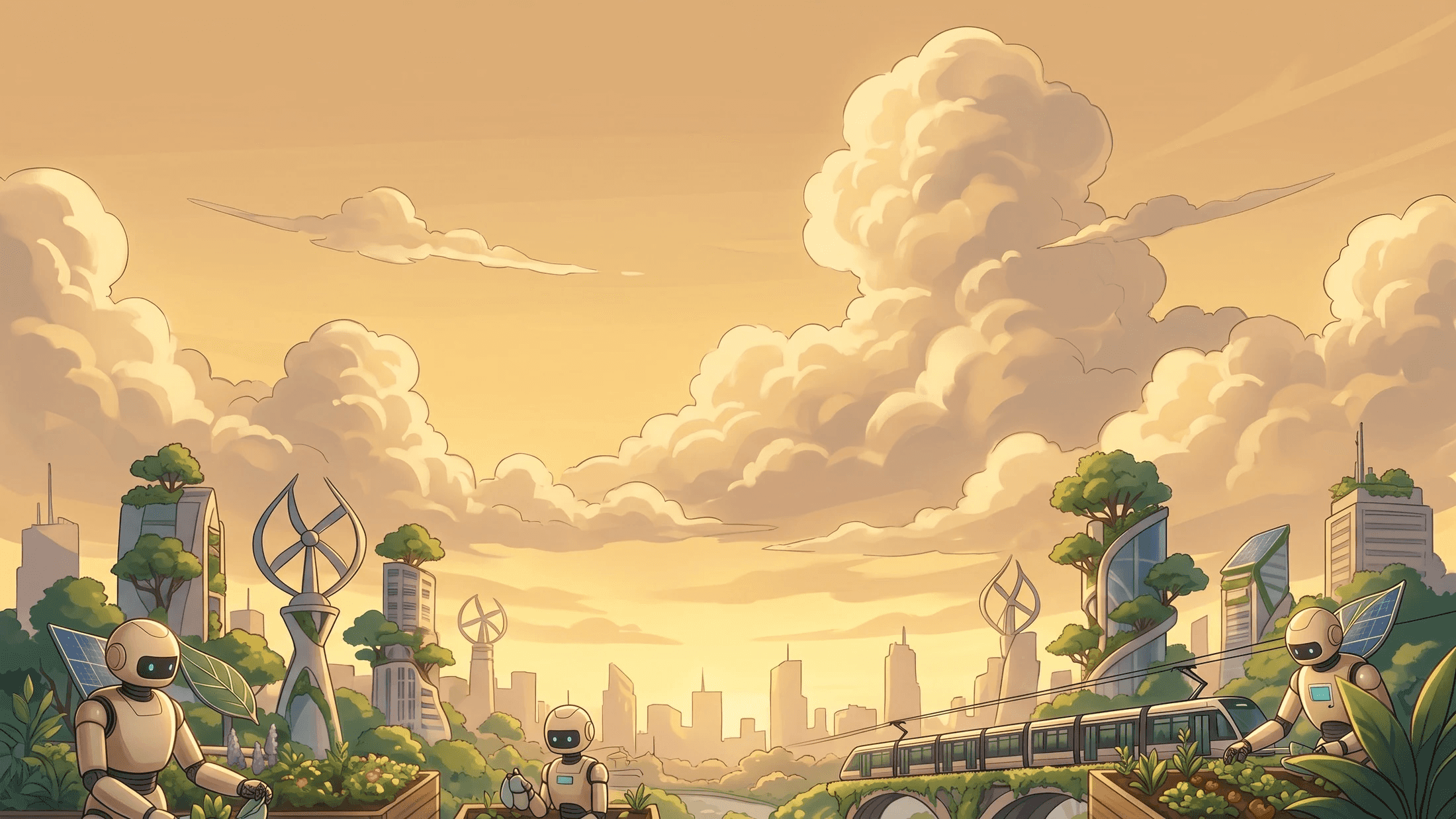
Universal basic goods and services, powered by machine labor on demand, distributed by universal basic capital.
In plain terms: every resident owns an equal share of their community’s machines, for energy, food, water, fabrication, and compute. Those machines make a free lifeline block of the essentials: food, water, energy, housing, healthcare, transport, and communication. Above the block, markets work the way they do today.
Universal basic capital comes from Google DeepMind’s economists, who rated it highest for agency of the eleven policies they studied, and recommend rolling it out in stages as machines take on more of the work. The Map lays out those stages.
Think of the power grid. The essentials should work like infrastructure: run on the most efficient market we know how to build, behind a guarantee nobody has to apply for.
And one rule sits above the machines: if a human wants to do a job, a human gets to do it. Machines fill whatever’s left. People team up around quests in parties and around crafts in guilds, because good work, done for its own sake, is part of a good life.
What you’ll find here
- The World We Want, the essay series, in two parts. Start with why the AI industry has never told you what’s in it for you.
- The Information Economy, the whitepaper that turns the series into a working design: ownership, lifeline blocks, governance, law, and pilots.
- The Map, how past economic systems gave way to the next, and the stages that could take us from here to there.
- The glossary and every source, linked.
How I work
Every claim is sourced. The whitepaper even includes a fact-check of its own first draft, including what it got wrong.
The design starts as simple as it can be, and anything more complex has to prove itself in a pilot first. If I’m wrong, I want to find out on a small scale.
Who I am
I’m Grant Harvey, and I write Futurespective on Substack.
This project grew out of two earlier essays. One proposed Data Foundries, where people train machines and share in what they earn. The other answered Sam Lessin’s argument that AI is a meaning crisis, not a labor crisis.
Get involved
Subscribe for new pieces, and argue with me in the comments. The best objections end up in the paper.
If you run a cooperative, a municipal utility, a town, or a research lab and want to test a piece of this, I’d love to hear from you. Reach me through Futurespective on Substack.