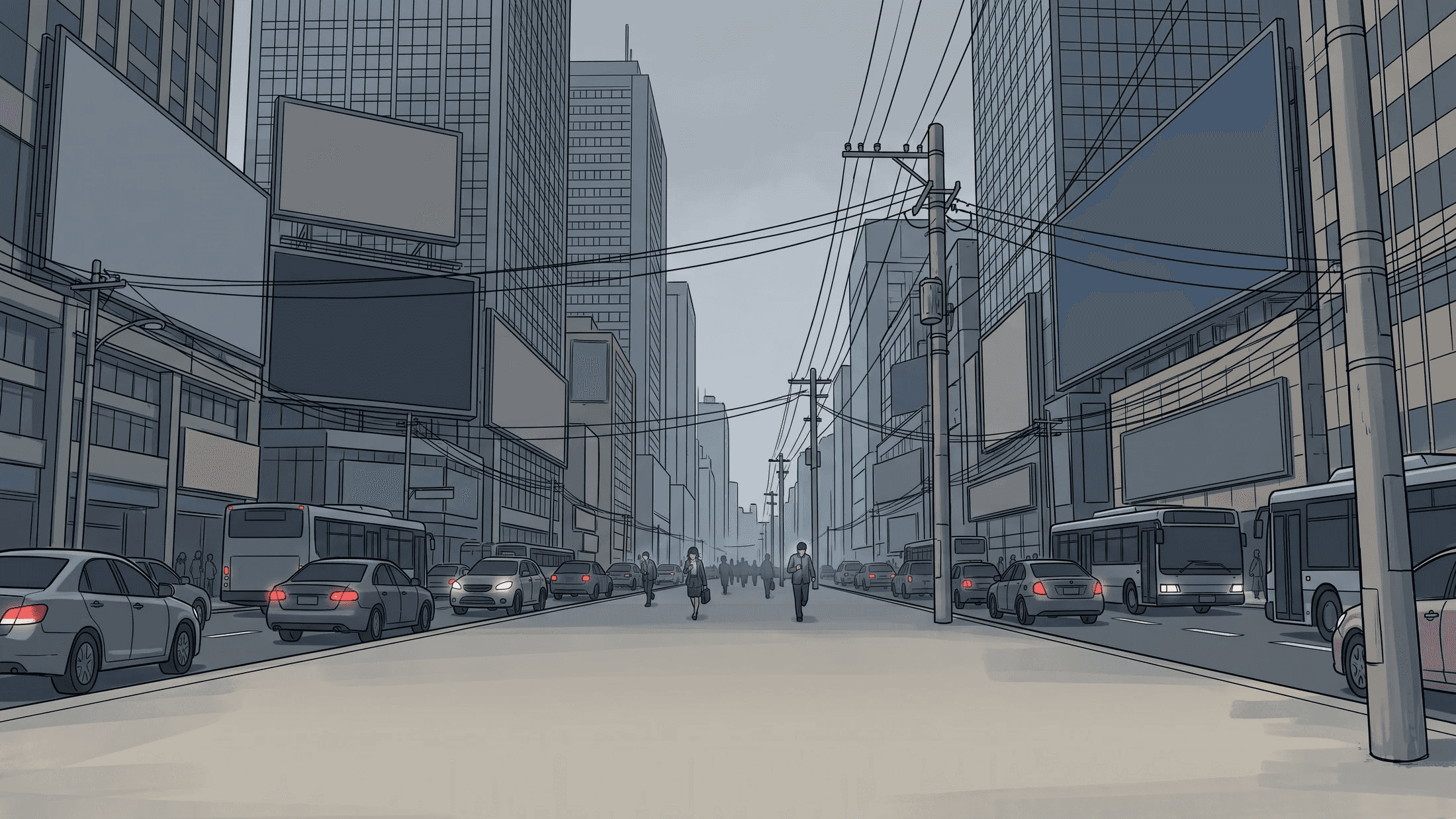
Plan for the Bad Transition
The road from here to the world we want, in five stages: what to build, what to watch, and a safety net switched on by data instead of dates, for the years before universal basic goods exist.

In Part 7: We’re Less Than a Decade From the Next Economic System, I argued that the next system gets codified within the next decade. This part is the road: five stages from here to the world we want, what to build in each, and the numbers that tell us where we are.
The floor, universal basic goods and services, shows up in Stage 4, somewhere around 2035 to 2045. And the dates are estimates, not promises.
Part 18 ended on the question that’s been bugging me: what if wages break before the floor is built?
The whole series fits in one line: universal basic goods and services, powered by universal machine labor on demand, distributed by universal basic capital. Every piece of that sentence takes years to build. None of it happens by next quarter.
A paycheck can disappear by next quarter.
So this road starts from the worst plausible path. Here’s the argument:
The floor breaks the spiral once it exists. The most dangerous period is the window before it does. So plan for the worst plausible path, and trigger the response with data, not dates.
The scenario to plan against
In February 2026, Citrini Research published The 2028 Global Intelligence Crisis, written with Alap Shah as a memo from June 2028, looking back. They’re upfront about what it is: “a scenario, not a prediction.”
The engine is a loop they call the human intelligence displacement spiral:
- AI gets better, so companies need fewer white-collar workers.
- Laid-off workers spend less.
- Lower spending squeezes company margins.
- To protect their margins, companies spend more on AI.
- AI gets better. Repeat.
In their words, “a negative feedback loop with no natural brake.” (A systems thinker would call it a reinforcing loop, but the point stands.)
By the memo’s date, unemployment is 10.2% and the S&P 500 is down 38% from its October 2026 high. Stress spreads from software loans into private credit, then to whether prime mortgages are still good.
Meanwhile, the economy keeps “growing” on paper. The memo calls it Ghost GDP: “output that shows up in the national accounts but never circulates through the real economy.”
The rebuttals were strong, and they deserve a fair hearing.
Frank Flight of Citadel Securities argued that AI is a positive supply shock: it lowers costs, expands output and raises real incomes. Citrini, he argued, confused recursive technology with recursive adoption: new tools spread along an S-curve.
Others pointed to the scenario’s quietest assumption: that governments stand still. They don’t. When COVID hit, Congress passed the $2.2 trillion CARES Act within weeks.
And the data so far cuts both ways. In August 2026, Erik Brynjolfsson, Bharat Chandar and Ruyu Chen at Stanford’s Digital Economy Lab found no evidence of widespread, economy-wide job displacement.
But employment for 22- to 25-year-olds in AI-exposed jobs stands 19% below where it would be had it kept pace with their less-exposed peers, and that gap keeps widening. They call these early, descriptive signals, not proof of cause.
So here’s where I land. The spiral is unlikely. It’s also the most damaging path that’s still plausible, and it’s the one the floor can’t stop if it arrives early.
We don’t write fire codes because we expect fires. We write them because fires are bad, and the code has to exist before the smoke.
Why the floor breaks the spiral, eventually
Look at the loop again. It runs through one link: households pay for necessities out of wages. When wages fall, spending on necessities falls, and the people who make and sell those necessities lose their jobs next.
Universal basic goods and services cut that link.
If your food, power, housing and healthcare don’t depend on your paycheck, losing your paycheck stops being a catastrophe. You don’t default on a home you aren’t paying for out of wages. You don’t skip a doctor’s visit you don’t pay for.
A household with a floor under it can’t spiral.
Why it can’t, yet
The floor is a slow fix. The spiral is a fast one.
The systems thinker Donella Meadows put it simply in her 1999 essay Leverage Points: “Delays in feedback loops are critical determinants of system behavior.”
Her example was electricity: power plants take years to build, so supply can never exactly match demand, and the industry swings between too much capacity and too little.
That’s our situation exactly. The floor is a years-long build. A wage spiral moves in months.
So until the floor exists, something faster has to sit beside it.
Meadows adds that you get the same swings when your information is timely but your response isn’t. Which brings us to the second delay, the one we actually control: the time it takes politicians to agree.
In Citrini’s scenario, the government spends 2028 debating a “Transition Economy Act” for direct payments to displaced workers, and a “Shared AI Prosperity Act” giving the public a claim on the returns of AI infrastructure.
Those are roughly the right ideas. They’re just being argued over during the fire. In the memo’s words, “the social fabric is fraying faster than the legislative process can move.”
That part isn’t fiction. In the Great Recession, as Rep. Don Beyer put it, “they re-upped Unemployment Insurance 13 different times” (via Equitable Growth). In 2020, Congress let key CARES Act provisions expire twice, leaving families unsure whether help would continue.
Triggers set in advance remove that delay. Decide now, while things are calm, what happens when the numbers cross a line. Then help arrives on the data’s schedule, not Congress’s.
This isn’t a new idea. In 2019, Claudia Sahm, then an economist at the Federal Reserve, proposed stimulus payments that go out automatically whenever the three-month average unemployment rate rises at least half a point above its low of the past year. No vote required.
From here to there, in five stages
Every system in Part 7 arrived the same way: a shock hit, and the people with prototypes ready wrote the rules for everyone else.
This time, we can see the shock coming. Which means, for once, we don’t have to wait for it. We can map the road ahead of time and start building now.
First, where we are. Part 7 sketched three phases: a scarcity phase (where we are now), a transition phase from roughly now to 2040, and an abundance phase after that. The transition phase is the next system, and I expect it to be short: a bridge to abundance.
Inside the transition, we’re in the handover, the stretch where one system of power gives way to the next. If Part 7’s pattern holds, it started around 2020 to 2022, and the next system gets codified between the late 2020s and the early 2030s.
The road runs through five stages. The first two stages are the handover itself: intelligence on demand, then machine labor on demand. The last three are deployment: we build it out, we gift it back, and the new system becomes everyday life.
Why should you care? Because every stage touches your life directly: the work you do, what you pay for the essentials, and who owns the things you depend on.
So for each stage, I’ve listed four things: what changes, what to build, the signposts to watch, and what switches on.
A signpost is a number we can check, like a mile marker on a highway. It tells us whether a stage is really under way, so we know when to move to the next one, instead of guessing from the calendar.
A trigger tells you what to do next, decided before you get there. When a signpost crosses its trigger, a switch flips, with no new vote.
Three switches, A, B and C, make up the safety net. They come from Julian Jacobs and Alex Imas, economists at Google DeepMind. In Economic Policy for AGI (September 2026), they argue for “flexible economic policy responses tied to clear empirical triggers,” so we neither act too late nor overreact.
They match three sets of policies to three scenarios. Here’s my version, with community nodes as the last step. And if the numbers turn early, say wages break sooner than expected, the build-out speeds up instead of waiting for its date.
The stages overlap, and the dates are estimates, not promises.
Stage 1: The machine intelligence age (now to about 2030)
What changes: Intelligence on demand is everywhere. AI handles a growing share of knowledge work, and the first services get automated. Wages start to stall in the most exposed jobs.
What to build: The prototypes. Pilot towns, in pairs: one with spare food and one with spare energy, each with about 1,000 to 5,000 people and two to three years to prove the model.
Each pair runs the simplest version: equal shares, a free first block of the essentials, and maintenance before dividends.
Alongside them, Data Foundries, the idea from my first post on Futurespective: places where people get paid to train robots and keep a share of what the robots earn. They’re a bridge for the years before the floor exists.
Legal templates for parties (single-purpose entities where the people doing the work are partners) and guilds (open-admission craft organizations with a charter obligation to train anyone who wants to learn).
Community ownership trusts that can hold infrastructure. And the first round of tax reform: the formula in Every Spending Bill Should Show Up on Your Paycheck.
Signposts: five numbers that show whether AI is starting to do the work.
Labor’s share of national income. The part of everything the economy earns that goes to workers as pay, instead of to owners as profit. If it keeps falling, machines are doing more of the work. In the US, it hit a record low of 52.8% in mid-2026.
What matters for the triggers below is the trend, not the level: a steady fall is the signal.
The share of tasks AI can do from start to finish. Not helping a person, but finishing the whole job. When that share rises, jobs stop being assisted and start being automated. Company filings give a second count: AI revenue as a share of the knowledge-work wage bill.
The employment gap for young workers in AI-exposed jobs. Entry-level jobs are where automation shows up first. Stanford’s Digital Economy Lab tracks the gap in its public AI Economic Indicators.
Payroll tax receipts as a share of federal revenue. How much of the government’s money comes from taxing paychecks. If that share shrinks while the economy grows, the old tax base is eroding.
Long-term real interest rates. What it costs to borrow for decades, after inflation. Trevor Chow, Basil Halperin and J. Zachary Mazlish show that if markets expected transformative AI, these rates would rise sharply, because people would borrow against a much richer future.
At 30% annual growth, real rates would top 30%; ten-year real rates in their developed-country sample have never gone above 5%. If the headlines are panicking and real rates are calm, the market isn’t buying the fast path. That includes my forecasts.
What switches on: Switch A, the first layer of the safety net. It has no trigger: we build it now, while things are calm.
Unemployment insurance for gig and contract workers. Jacobs and Imas note that US unemployment insurance typically excludes gig workers and freelancers.
A monthly earned income tax credit, including workers without children. The earned income tax credit (EITC) tops up the pay of low earners. Today it largely leaves out workers without dependents, and it arrives once a year at tax time.
Employer-led apprenticeships. In Jacobs and Imas’s reading of the evidence, public retraining programs have historically disappointed, while apprenticeships and employer-led models succeed “by a considerable margin.”
Here’s the thing: we’ve already done most of Switch A. Temporarily.
In March 2020, the CARES Act extended unemployment benefits to self-employed workers, independent contractors, freelancers and gig workers.
In 2021, the American Rescue Plan nearly tripled the maximum EITC for workers without qualifying children, from $543 to $1,502, for 2021 only. That same year, the IRS sent monthly child tax credit payments to families.
Each one was built in a crisis and allowed to lapse. Switch A is just making them permanent before the next one.
Stage 2: Machine labor arrives (about 2028 to 2035)
What changes: General-purpose robots start filling labor shortages in logistics, construction, care, and services. Prices for automated services fall. So does demand for the human labor that used to provide them.
What to build: A real transition safety net.
This is where I’ll concede something to the UBI camp: during the transition, a cash bridge makes sense. A check is the wrong destination, but it may be the right bridge while the goods themselves are still being built.
Pair it with in-kind provision wherever costs are already falling, starting with healthcare and housing. And start shifting taxes off human labor.
Signposts: four numbers that show machine labor arriving, and who it’s paying off for.
Robot deployments per worker. How many robots are at work for every human worker. When it climbs, machine labor on demand is arriving. Track what a robot costs per hour of work, too.
The prices of services that machines now provide. If machines are really doing the work, those prices should fall. If they don’t, the savings are going somewhere else.
Watch the essentials against overall inflation, too: food at home, shelter and energy, from the Bureau of Labor Statistics’ Consumer Price Index. That comparison tells you which kind of trouble you’re in (more below).
The gap between productivity growth and wage growth. Productivity is how much the economy produces per hour of work. If output keeps rising while wages don’t, the gains are flowing to whoever owns the machines.
Long-term unemployment and median wages. How many people have been out of work for months, and what the typical worker earns. When both get worse together, wages are compressing.
What switches on: Stage 2 itself, on data: when AI revenue reaches a set share of the knowledge-work wage bill, or the young-worker gap passes a set threshold. By then, Switch A should already be law.
Then Switch B, when wages compress. When long unemployment spells rise and median wages fall for a set period, the EITC converts into a negative income tax: a cash floor that pays out when your income falls below a threshold and phases out as it rises.
Milton and Rose Friedman put forward the first concrete proposal in Capitalism and Freedom (1962), though the British politician Juliet Rhys-Williams sketched the idea in the early 1940s. Friedman wanted one simple cash floor in place of a tangle of programs.
Unlike a universal basic income, it pays only people whose income has fallen, which, as Jacobs and Imas point out, makes it much cheaper.
Switch B is the bridge, and it switches on first. The cash path ends in the universal monthly cash floor in Every Spending Bill Should Show Up on Your Paycheck, which phases in. In year one, it pays what today’s consolidated benefit programs already cost, so the tax rate doesn’t jump.
From there, the floor grows with the tax base until it reaches its full size, about 5 points of the rate. Switch B keeps topping people up whenever wages fall.
That floor is the end state of the cash path, not of the series. It shrinks as each essential moves in kind. The destination is the lifeline block in Stage 4.
Stage 3: The build-out (about 2030 to 2040)
What changes: The scarcity flywheel spins up. AI-driven materials science, chemistry, and energy research start cutting the cost of the bottleneck goods.
Communities build microgrids for what they can’t go without: energy, water, and buffers of food and medicine. They trade for the rest, like chips and steel, which are far cheaper made at scale, for now.
The goal at this stage is resilience, not self-sufficiency: a town that can run its essentials through a disruption, without making itself poorer by making everything.
What to build: Community nodes, built by parties (at first, AI-enabled startups, or “neo-labs”) as quests and financed by private capital and public investment, with the gift-back written into the charter from day one: when a node hits its sufficiency milestones for those critical needs, ownership transfers to the town’s trust, held for the people who live there, one equal share each.
Guilds document and teach the crafts the nodes need.
Signposts: three numbers that show the build-out working where people live.
The share of a town’s basic needs produced locally. How much of its power and water a town makes for itself, and how many weeks of food and medicine it keeps on hand. When it rises, the nodes are doing their job.
Energy cost per kilowatt-hour. Energy is the input to everything else, so when it gets cheaper, almost everything else can too.
Housing cost per square foot. Housing is the biggest bill most families have. If the build-out works, this is where people will feel it.
What switches on: The build-out at full speed, once two things hold together: general-purpose robots fall below a set cost per hour of work, and pilot nodes have passed their two-year tests. Cheap robots without a proven node design just build the wrong thing faster.
And Switch C, when labor decouples. If labor’s share of income keeps falling for several years while returns to capital rise, accelerate universal basic capital: speed up the node build-out and the gift-back.
Pay a national frontier dividend, the public’s share of frontier AI profits, into community investment funds that build nodes, instead of mailing it out.
Jacobs and Imas describe universal basic capital as something that could be “designed now but deployed” once the data shows that decoupling. That’s the right posture. On their panel’s agency scores, it ranked first of eleven policies, at 76.3 out of 100.
Notice what Switch C is: roughly Citrini’s Shared AI Prosperity Act. The difference is when you write it.
Stage 4: The gift-back and the floor (about 2035 to 2045)
What changes: Infrastructure transfers to communities at scale. Universal basic goods and services become real: walk into a store, take what you need, walk out. Money persists for whatever stays scarce.
In practice, that’s a lifeline block: each household’s first block of food, water, energy, housing, healthcare, transport, and communication is free, along with personal AI and personal machine labor. No application, no means test.
Use above the block has a price, the way utilities price power, which curbs waste without policing anyone. That revenue maintains the machines first, and only then pays dividends.
As each essential moves into the block, the cash floor shrinks with it, down to a little cash for extras and for whatever stays scarce.
Machines guarantee the floor; people choose their work. Machines run the essentials no matter who shows up, and everywhere else, humans get first pick.
What to build: The surplus-on-request network that links communities, so a town on farmland can cover a town in the desert.
Run it like the power grid. Towns trade surplus in a regional market, run by their federation, where a shortage shows up as a high price and pulls supply toward it.
Households never see that price. Their essentials sit behind the lifeline block, and a shared reserve backs up any town hit by a drought or a fire.
And a narrower government whose job is guaranteeing the floor: making sure every community gets built out, and settling disputes between communities.
Signposts: two numbers that show the floor is real.
The share of household spending that goes to essentials. How much of a family’s budget goes to what the lifeline block covers, from food and housing to energy and healthcare. When the floor is real, that share heads toward zero.
The number of communities that have taken ownership of their nodes. The gift-back, counted. Each one is a town where every resident owns an equal share of the machines that provide for it.
What switches on: The gift-back at scale, when labor’s share falls by a set amount over a few years, or nodes hit their sufficiency milestones, whichever comes first.
That “whichever comes first” is the point of this whole piece. Good news can pull the floor forward. So can bad news. If the spiral starts, the build-out speeds up instead of waiting for its date on a chart.
Stage 5: Node states (2040 and beyond)
What changes: A network of resilient communities becomes the main way people organize their lives, connected by trade in information and resource surplus rather than wages.
Resilient means every town can run its essentials on its own through a crisis, and trades for everything else.
Sometime between 2040 and 2050, if this works, node communities go beyond resilient. They become self-sufficient enough to exchange resources above their surplus freely with each other, and that’s what makes a world where we can each do whatever we want.
At the limit, that means self-sufficiency by region: each group of towns covers its own needs, with plants sized to the region they serve, surplus built in, and everything made to be recycled.
Parties and guilds replace most corporate employment. Growth turns outward: mining beyond Earth to feed every region’s fabs, and eventually, other planets.
What to build: Whatever we haven’t thought of yet. By this stage, the people living in the system will know better than I do.
One dashboard
Every switch depends on measurement, so every signpost above goes on one public dashboard. The thresholds below are illustrative. A real program would set them in law ahead of time, as Sahm proposed for hers.
- Labor’s share of income (Stage 1). Bureau of Labor Statistics: 52.8% in the second quarter of 2026, the lowest since 1947. Trigger: down more than 3 points in 3 years. Switches on Switch C. Off: none; the build-out keeps going.
- The share of tasks AI can do from start to finish (Stage 1). Task benchmarks, plus AI revenue as a share of the knowledge-work wage bill from company filings. Trigger: AI revenue above a set share. Switches on Stage 2.
- The young-worker employment gap (Stage 1). Stanford’s AI Economic Indicators: 19%, on data through June 2026. Trigger: above 25%. Switches on more apprenticeships, gets Switch B ready, and starts Stage 2.
- Payroll taxes and federal receipts (Stage 1). Congressional Budget Office. Trigger: receipts short of forecast by more than a set share. Switches on a faster shift of the tax base off labor.
- Long-term real interest rates (Stage 1). Inflation-protected Treasury bonds. Trigger: a sustained, sharp rise. No automatic response: it’s a reality check on everyone’s forecasts.
- Robots per worker, and their cost per hour of work (Stage 2). Trigger: cost below a set level, and pilot nodes past their two-year tests. Switches on the full build-out.
- Prices of the essentials against overall inflation (Stage 2). Consumer Price Index: food at home, shelter and energy. Trigger: essentials rising faster than overall prices for two quarters. Switches on capacity and in-kind provision, instead of more cash. Off: two quarters back in line.
- Long-term unemployment and median wages (Stage 2). Bureau of Labor Statistics. Trigger: both worsening for two straight quarters. Switches on Switch B. Off: both improving for two straight quarters.
- Local share of a town’s basic needs (Stage 3). Each town trust’s own books. Trigger: sufficiency milestones met. Switches on the gift-back.
- Watched, not wired: the productivity-wage gap, energy and housing costs, household spending on essentials, and the number of towns that own their nodes. They tell us where we are.
Notice that most of these watch the change, not the level. Labor’s share is already at a record low, but a slow drift isn’t a spiral. Sahm’s trigger works the same way.
Triggers need off-switches too. David Mitchell and Corey Husak at Equitable Growth made the case in 2021 that “off-triggers” beat arbitrary end dates.
When the numbers recover, the cash steps back down. The build-out keeps going on its own gates either way.
As of this writing, none of these has fired. The Yale Budget Lab’s verdict is in its title: AI Is Probably Not (Yet) the Reason for Labor Market Weakening (May 2026). Note the “yet.”
Match the tool to the regime
This is where I owe the UBI camp a cleaner answer.
In Part 6: UBI Won’t Work. Universal Basic Goods Will., I wrote that “if everyone gets more money while the supply of housing, healthcare, and food stays the same, prices rise to absorb it.
A check only works if there’s enough of the things it buys, and making enough is exactly the problem machine labor should solve.”
I still believe that. But it’s an argument about one kind of economy: one where goods are scarce. And in Stage 2, I conceded that a cash bridge makes sense while the goods are still being built.
The research gives me a better way to say what I meant. The right tool depends on the regime:
- Demand shortfall (deflationary). Warning signs: falling prices, rising unemployment, weak spending. The goods exist, and nobody can afford them. Use cash: a negative income tax, plus credit forbearance. More money doesn’t push up prices when shelves are full and prices are already falling.
- Supply shortage (inflationary). Warning signs: rising prices for essentials, shortages. Here Part 6 holds: more cash just bids up the same scarce goods. Build capacity, and provide it in kind.
- Ownership shock (labor decoupling). Warning signs: labor’s share falling while capital returns rise. Neither cash nor goods fixes who owns the machines. Universal basic capital does.
So Part 6 and the cash bridge weren’t contradicting each other. They were describing different weather.
A check is the right tool for a demand collapse and the wrong one for a shortage. The dashboard’s row for the prices of essentials tells you which one you’re in.
Credit and housing
In Citrini’s scenario, the deepest damage comes through debt: white-collar incomes underpin a $13 trillion mortgage market, and private credit lent heavily against software revenue that stopped recurring. Three measures limit it.
- A forbearance protocol, legislated in advance. In 2020, the CARES Act let borrowers with federally backed mortgages pause payments for as long as two consecutive 180-day periods. That template was written in a panic. Write the next one now, triggered when a household’s income falls past a set threshold, so nobody loses a home while Congress debates.
- Housing nodes first, on land trusts. Housing is the biggest debt most families carry, so community housing belongs early in the build-out, on community land trusts: the trust holds the land, residents lease it long-term (often for 99 years), and homes resell at restricted prices so they stay affordable. They’ve held up in a crash before. At the end of 2010, 1.30% of mortgages held by land trust homeowners were seriously delinquent, against 8.57% in the conventional market, in Emily Thaden’s survey for the Lincoln Institute. It’s a survey, not an experiment, but it points the right way.
- Watch private credit. The IMF estimated that the private credit market topped $2.1 trillion globally in 2023, about three-quarters of it in the US, and warned that “valuation is infrequent” and the links between lenders are unclear. Regulators should track its exposure to the sectors where AI cuts revenue fastest, starting with software sold by the seat.
The fiscal half
There’s a catch. The bridge costs money exactly when money gets scarce.
Of the $5.2 trillion the federal government collected in fiscal 2025, about $3.5 trillion was withheld from paychecks as income and payroll taxes, according to the Congressional Budget Office.
Citrini’s memo calls the revenue base “essentially a tax on human time.” In their scenario, receipts run 12% below CBO’s projections, right when the government needs to send households more.
That’s the strongest argument for moving the tax base toward capital and rents early, while the transition is still gradual.
I worked through the details in Every Spending Bill Should Show Up on Your Paycheck. The short version: one formula sets the tax rate every year, with capital income paying more than wages, plus a debt surcharge that retires the debt.
Two features matter here. The surcharge pauses automatically when the dashboard shows a demand shortfall, so paying down debt never deepens a spiral. And the formula uses the trend tax base, not last year’s, so a downturn doesn’t raise anyone’s rates.
One dashboard runs both halves.
A physical deadline
There’s a physical deadline, too. The Limits to Growth (1972), by Donella Meadows and her co-authors, ran a computer model of the world economy against the planet’s resources.
In 2021, the researcher Gaya Herrington checked its scenarios against real data. The closest fits showed “a halt in welfare, food, and industrial production over the next decade or so” (Journal of Industrial Ecology), right on top of the build-out.
The model behind those scenarios, World3, shows why. As the easy deposits run out, getting resources out of the ground takes more and more capital, which leaves less for industry, food and services. Industrial output peaks and declines, and pollution adds drag on top.
This series is my counter-offer. Point machine intelligence at what’s scarce, so finding and substituting materials gets cheaper instead of costlier. Make everything recyclable and close the loops, so we conserve the stocks and stay abundant in the flows (more on that in Part 9).
Run it all on efficient machines and renewable energy, put the essentials first and maintenance before expansion, and you’re close to the choices behind the one scenario Herrington tested that avoids a decline: the “stabilized world.” Over the long run, asteroid mining takes the pressure off Earth’s stocks.
To be clear, World3 has no AI in it, and Herrington calls her results preliminary. Read it as a warning, not a forecast, and one more reason to start building now.
What could go wrong
Plenty. The installation phase of every technological revolution concentrates wealth, and incumbents will fight to keep it. A shock could arrive before the prototypes are ready, and the people with the worst ideas might be the ones holding them.
AI could stay locked inside a few companies. Some communities could be left behind. And every date above could slip.
Isn’t this just UBI with extra steps?
No. A UBI pays everyone, always, on top of whatever they earn. Switch B pays only people whose income has fallen, phases out as they recover, and switches on only when the data shows wages compressing.
It’s the bridge. The cash floor in the tax formula nets out for most working adults, and it shrinks as the essentials move in kind. The extra steps are the point. Each one matches the tool to the problem.
Won’t the triggers fire too late?
Some will. Jacobs and Imas warn that official datasets “may lag real-world disruption.” So there are three defenses.
Switch A has no trigger at all; it’s built now. Most triggers watch the rate of change, which can catch a turn before the levels look alarming. And some indicators, like Stanford’s, run on high-frequency payroll data.
A trigger that fires a quarter late still beats thirteen political fights.
What if the spiral never comes?
Then good. Switch A is sound policy in any economy: as Jacobs and Imas note, the data shows the EITC to be one of the most successful poverty reduction programs in history.
Switches B and C sit in law, unused, costing nothing, like a fire code in a building that never burns.
Each of these risks has the same answer, the one history keeps teaching: build the prototypes now, track the signposts honestly, and be ready when the window opens.
Something ready, for the worst case too
Worldbuilders want a steering wheel. But a steering wheel only helps if you learned to use it before the ice.
In Part 7, I wrote: “What came next depended on what was ready to replace it.” That’s true of the destination. It’s also true of the bridge.
The floor is still the answer. Once it exists, the spiral loses its fuel. Our job is to make sure everyone is still standing when we get there.
For how surplus moves between towns once the floor is built, read Keep Money, Add a Second Ledger.
The floor takes years. One bridge can start now, with no new tax, because robotics companies are already paying for it: Part 20: Get Paid to Train the Robot That Takes Your Job.

The spiral
Cut one link and the loop stops
a negative feedback loop with no natural brake.

From here to there
Five stages: two of handover, three of deployment
HandoverDeployment

Handover · Now to about 2030
Stage 1: The machine intelligence age
What changes
Intelligence on demand is everywhere. AI handles a growing share of knowledge work, and the first services get automated.
What to build
The prototypes.
Signposts
Five numbers that show whether AI is starting to do the work.
- Labor’s share of national income.
- The share of tasks AI can do from start to finish.
- The employment gap for young workers in AI-exposed jobs.
- Payroll tax receipts as a share of federal revenue.
- Long-term real interest rates.
What switches on
Switch A, the first layer of the safety net.

Handover · About 2028 to 2035
Stage 2: Machine labor arrives
What changes
General-purpose robots start filling labor shortages in logistics, construction, care, and services.
What to build
A real transition safety net.
Signposts
Four numbers that show machine labor arriving, and who it’s paying off for.
- Robot deployments per worker.
- The prices of services that machines now provide.
- The gap between productivity growth and wage growth.
- Long-term unemployment and median wages.
What switches on
Switch B, when wages compress.

Deployment · About 2030 to 2040
Stage 3: The build-out
What changes
The scarcity flywheel spins up.
What to build
Community nodes, built by parties (at first, AI-enabled startups, or “neo-labs”) as quests and financed by private capital and public investment
Signposts
Three numbers that show the build-out working where people live.
- The share of a town’s basic needs produced locally.
- Energy cost per kilowatt-hour.
- Housing cost per square foot.
What switches on
Switch C, when labor decouples.

Deployment · About 2035 to 2045
Stage 4: The gift-back and the floor
What changes
Infrastructure transfers to communities at scale. Universal basic goods and services become real: walk into a store, take what you need, walk out.
What to build
The surplus-on-request network that links communities, so a town on farmland can cover a town in the desert.
Signposts
Two numbers that show the floor is real.
- The share of household spending that goes to essentials.
- The number of communities that have taken ownership of their nodes.
What switches on
The gift-back at scale, when labor’s share falls by a set amount over a few years, or nodes hit their sufficiency milestones, whichever comes first.

Deployment · 2040 and beyond
Stage 5: Node states
What changes
A network of resilient communities becomes the main way people organize their lives, connected by trade in information and resource surplus rather than wages.
What to build
Whatever we haven’t thought of yet. By this stage, the people living in the system will know better than I do.
Growth turns outward: mining beyond Earth to feed every region’s fabs, and eventually, other planets.
The stages overlap, and the dates are the essay’s estimates. Drag the year or pick a stage to see what changes, what to watch and what switches on.

A safety net with three switches
Decide now. Let the data flip the switch.
Illustrative thresholds, as in the essay
Switches B and C sit in law, unused, costing nothing, like a fire code in a building that never burns.
A toy run: the slider drives two of the essay’s dashboard rows past its illustrative triggers. A real program would set them in law ahead of time.
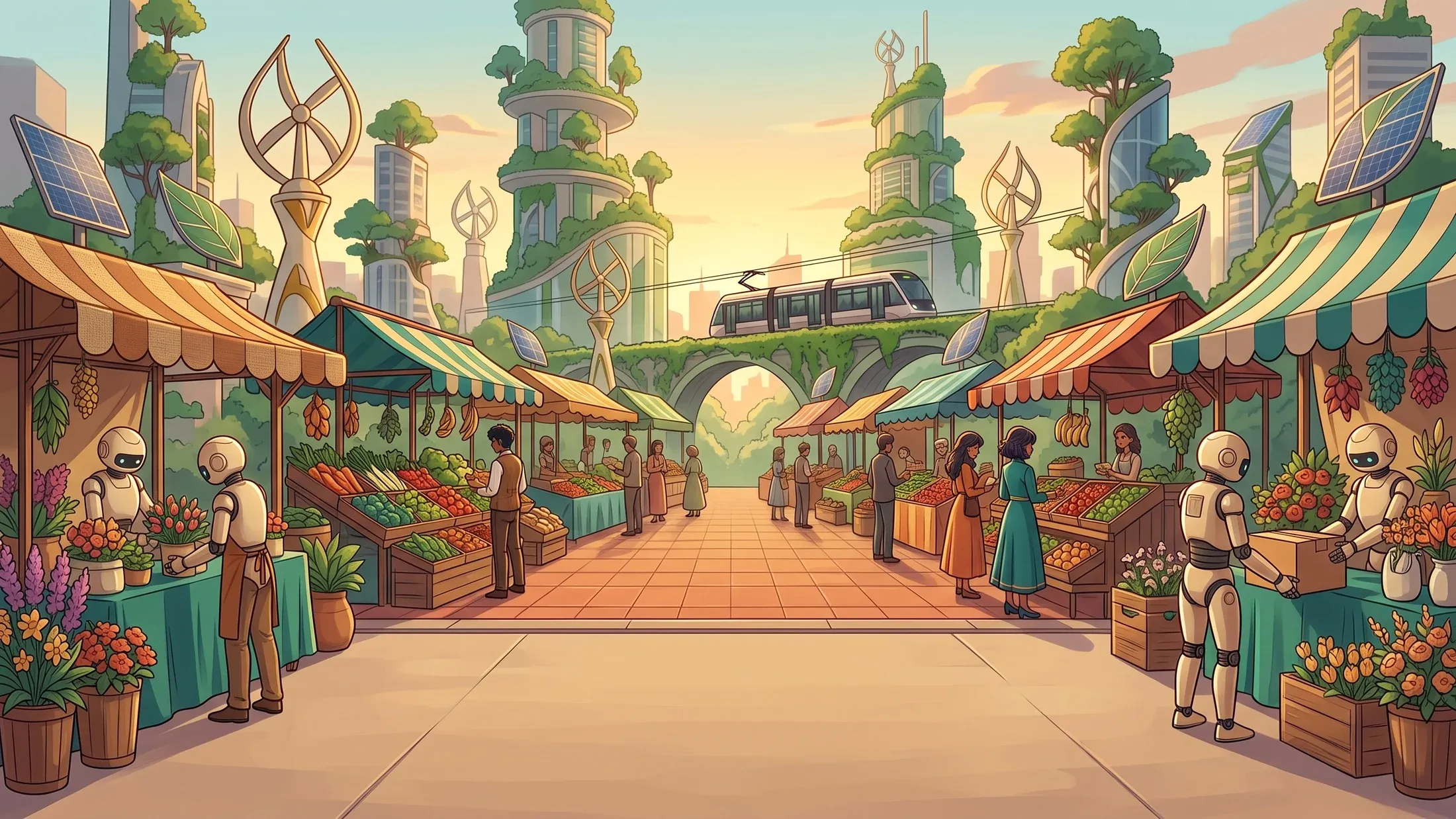
Match the tool to the regime
Different weather, different tool
Warning signs: falling prices, rising unemployment, weak spending.
Futurespective
The AI industry has had years to tell you what’s in it for you. They failed. Here’s my attempt...
New essays from Futurespective, in your inbox.