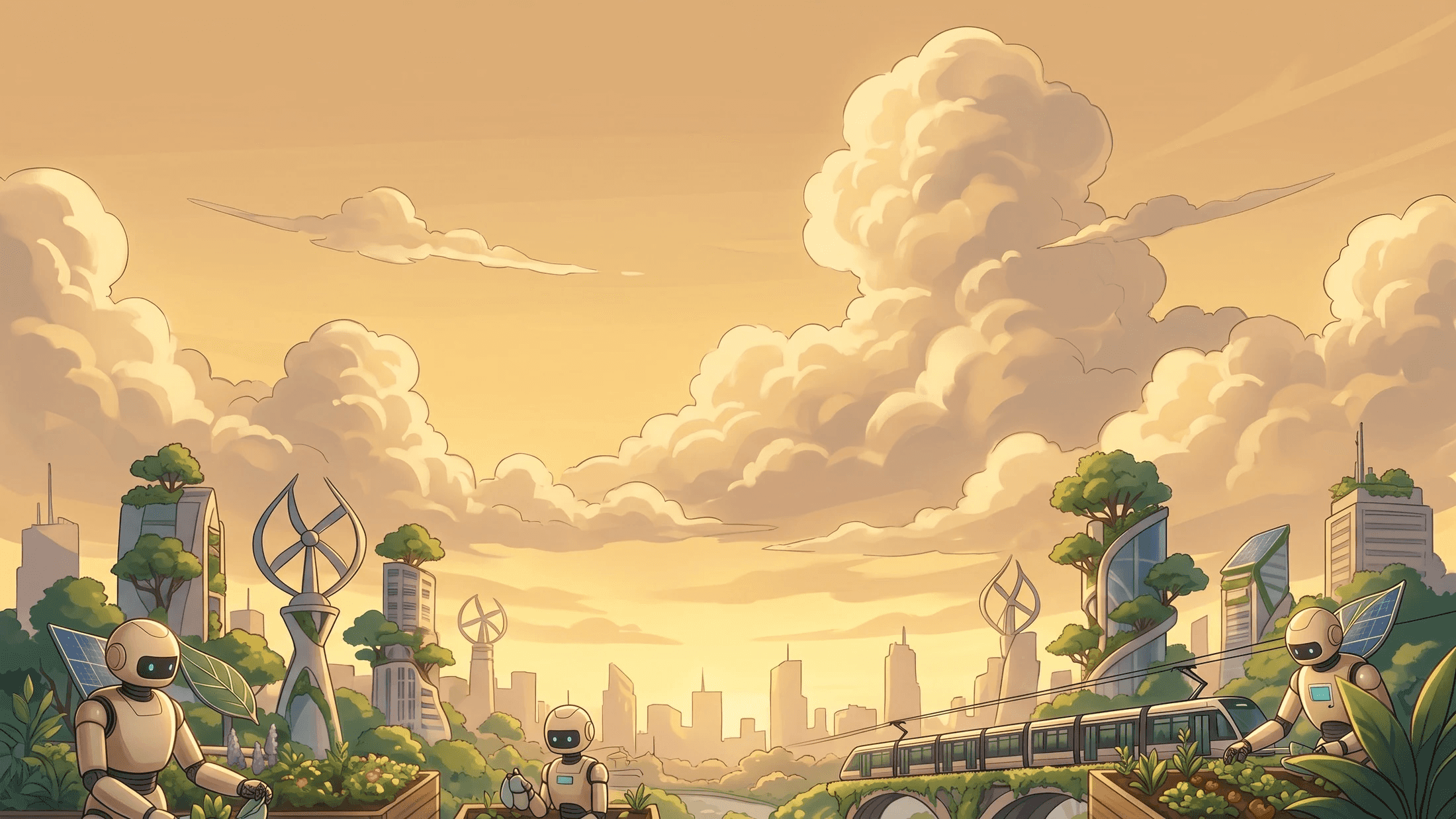
Above Self-Actualization Is the Universe
Maslow’s pyramid didn’t stop where the textbooks say it does, and once machines take care of the base, the top is bigger than any one of us.

My animated video for this series ends like this:
“That’s what safety really means: the base of the pyramid, food, shelter, health, simply taken care of. So everyone gets to climb higher.
To belonging. To growth. To purpose.
And up there, we pursue the two things AI can’t automate: curiosity... and caring for each other. You’re free... because you’re safe.”
I still believe every word of that.
That’s the pair from Part 8: curiosity and care, where care means service.
But I left something out. The pyramid has another floor.
Most of this series has been about the bottom of it. Machine labor on demand. Universal basic goods and services.
Towns that own their own power plants. All of that is plumbing, and plumbing matters. Nobody climbs anything while they’re worried about rent.
Here’s the thing, though. A world that only solves the plumbing is a very comfortable place to get stuck.
Book Two has worked its way up from there: a companion of your own, a skill tree instead of a career, and in Part 15: The Olympics, but for Everything, a league for every craft.
So this piece is about the top: what we’re climbing toward once the base is handled. My claim is simple. The world we want should aim higher than pure materialism.
It should help every person become who they are, and it should send us out to explore the universe. We can do both. In fact, I think they’re the same climb.
The pyramid Maslow didn’t draw
Let’s start with the original arbiter.
In 1943, the psychologist Abraham Maslow published “A Theory of Human Motivation” in Psychological Review. He laid out five kinds of needs: physiological, safety, love, esteem, and at the top, self-actualization.
His summary of that last one is still the best: “What a man can be, he must be.” A musician has to make music. A poet has to write.
(Maslow didn’t coin “self-actualization,” either. He credits the neurologist Kurt Goldstein for the term, right there in the paper. Original arbiters all the way down.)
Now, two things about that paper surprise most people.
First, Maslow never drew a pyramid. In a 2019 paper in Academy of Management Learning & Education, the management scholars Todd Bridgman, Stephen Cummings, and John Ballard traced the famous triangle back through old textbooks.
As the psychologist Scott Barry Kaufman summarized in Scientific American, they found no pyramid anywhere in Maslow’s published work. The earliest published one they found came from a consulting psychologist named Charles McDermid, in a 1960 Business Horizons article about how money motivates workers.
So the most famous diagram in psychology was first published in a business journal, in an article about money. That explains a lot.
Second, Maslow didn’t think the levels were rigid. He wrote in the same paper that the hierarchy was not nearly as fixed as he may have implied. People chase several needs at once, and go back and forth.
To make the point, he offered some figures he openly called arbitrary: the average person might be 85% satisfied in their physiological needs, 70% in safety, 50% in love, 40% in esteem, and just 10% in self-actualization.
Ten percent. That was his guess for the top floor, in 1943.
The evidence since then is mixed, and it’s worth being honest about it. In 2011, Louis Tay and Ed Diener tested Maslow’s needs against Gallup World Poll data from more than 60,000 people in 123 countries.
Meeting needs mattered for well-being everywhere. But the order didn’t hold strictly: people reported good relationships and a sense of self-actualization even when their basic needs weren’t fully met.
Basic needs tracked most closely with how people rated their lives overall, while social needs tracked most closely with positive feelings day to day.
So here’s how I read it. The levels are real. The ladder isn’t a ladder.
People reach for meaning even when they’re hungry. They just shouldn’t have to.
That’s the case for the floor. Not that nobody can climb without it, but that far more people would.
The floor Maslow added
Here’s the part the textbooks usually skip.
Late in his career, Maslow kept studying the healthiest, most fulfilled people he could find, and he noticed something odd. Some of them weren’t primarily focused on themselves at all.
In a 1969 paper called “The Farther Reaches of Human Nature,” published in the first issue of the Journal of Transpersonal Psychology, he wrote that the fully developed person tends to be “motivated by values which transcend his self.” Truth. Beauty. Justice. Things that don’t live inside your skin.
He gathered this work into a book of the same name, The Farther Reaches of Human Nature, published in 1971, the year after he died.
In 2006, the psychologist Mark Koltko-Rivera made the case in Review of General Psychology that the standard version of Maslow is out of date.
In Maslow’s later thinking, Koltko-Rivera argued, there’s a level above self-actualization: self-transcendence, the drive to serve or connect with something greater than the individual self. (Greater Good has a readable summary.)
That changes the shape of the whole thing.
Self-actualization is about becoming fully you. Self-transcendence is about realizing that you were never the whole story.
Soul alignment (or whatever you want to call it)
I’ve been looking for language for this for a while, and the closest I’ve come is soul alignment.
By that I mean the moment you realize you’re part of a greater body of intelligence, and life, and spirit.
People get there by different roads, and they call it different things:
- Soul alignment, my phrase for it: the feeling of your own life lining up with something much bigger than you.
- The cosmos knowing itself. Carl Sagan’s version, which I’ll come back to below: that we’re the way the universe gets to understand itself.
- Finding your faith. For billions of people, this is God, and the road there is religion.
- Nirvana. In the Buddhist tradition, nirvana is the “blowing out” of craving, and of the suffering it causes.
- The galaxy-brained version. A civilization-wide quest to climb the Kardashev scale, the ranking the Soviet astronomer Nikolai Kardashev proposed in 1964 for how much energy a civilization can harness (a planet’s, then a star’s, then a galaxy’s), and spread life among the stars. Elon Musk has described his own “religion, for the lack of a better word,” as “one of curiosity”: expanding consciousness on Earth and beyond it.
Or whatever you want to call it. I’m not here to tell you which word is right. I’m here to say that the feeling is real, people from every background report it, and it seems to be good for us.
If that sounds soft, the science behind it is surprisingly concrete.
In 2003, the psychologists Dacher Keltner and Jonathan Haidt published a paper that became the starting point for the modern study of awe, “Approaching awe, a moral, spiritual, and aesthetic emotion”.
Their definition has two parts: you perceive something vast, and it forces you to update your picture of the world, because it doesn’t fit the one you had.
Since then, researchers have found something they call the small self.
- At a scenic lookout over Yosemite Valley, tourists drew themselves smaller when asked to sketch a self-portrait than tourists at San Francisco’s Fisherman’s Wharf did. The more awe people felt, the smaller the self they drew.
- In a study led by Paul Piff, people who spent one minute gazing up at a grove of towering eucalyptus trees picked up more pens for a stranger who “accidentally” dropped them than people who spent that minute looking at a building.
- Older adults who took a 15-minute “awe walk” each week for eight weeks reported more positive emotion and less distress than people who just walked. Over time, the awe walkers took selfies where they got smaller and the landscape got bigger.
And here’s the finding I think about most. When Keltner’s team gathered awe stories from people in 26 countries for his 2023 book Awe, the most common source wasn’t mountains or music or religion.
It was other people: their courage, kindness, and strength. Keltner calls it moral beauty, and he reports that more than 95% of it involved people acting on behalf of others.
In other words, caring for each other is the most common doorway to the top of the pyramid.
A caution, because this series tries to be honest about evidence: the science of awe is young, and effects measured in a lab tend to be smaller than the headlines about them.
Treat it as promising, not settled. But the direction is consistent. A smaller self tends to make a kinder person.
Curiosity is the catalyst
So how do you get from self-actualization to self-transcendence?
I think the answer is curiosity.
In 1994, the economist and psychologist George Loewenstein published “The Psychology of Curiosity” in Psychological Bulletin.
His information-gap theory says curiosity is what you feel when you notice a gap between what you know and what you want to know. It’s a kind of itch.
The twist is that the itch grows as you learn. Complete ignorance doesn’t make you curious, because you don’t know what you’re missing. A little knowledge shows you the gaps.
In 2015, the cognitive scientist Celeste Kidd and the neuroscientist Benjamin Hayden reviewed the research in Neuron: people tend to be most curious about things they know a moderate amount about, and the brain’s reward system appears to treat information a lot like it treats other rewards.
Now follow that loop out to its end.
You get curious about something small. Why does bread rise? You learn about yeast.
Then fermentation. Then microbes. Then the fact that your own body carries trillions of them.
Then the fact that life on Earth spent billions of years as microbes before anything like us showed up. Then you’re lying on your back at night wondering whether there’s yeast on Europa.
Curiosity starts with your question. Followed far enough, it always ends at the question.
That’s the bridge. Self-actualization is mastering your craft. Curiosity, pursued past the edges of your craft, is what turns mastery into wonder, and wonder into a sense that you belong to something enormous.
Or as Carl Sagan put it in the first episode of Cosmos in 1980: “We are a way for the cosmos to know itself.”
Two summits, one pyramid
Here’s where this connects back to the rest of the series.
The top of the pyramid has two summits. One is personal. The other is collective.
The personal summit is self-actualization. In Part 1: Machines Can Make Us Both Free and Safe, I wrote that a world where your needs are met “is a world of ultimate self-actualization.” The machinery for that is already in the series:
- The human-will rule makes sure you’re never crowded out of the work you want to do.
- Guilds are where you go for mastery: open admission, and a charter obligation to train anyone who wants to learn.
- Parties and quests are where you go for purpose: a goal worth doing, with people you actually want to do it with.
The collective summit is the frontier. In Part 5: Every Town Can Own Its Own Power Plant and Chip Fab, I wrote that asteroid mining is “where our biggest ambitions come in, like reaching other planets and someday terraforming them.”
In Part 19: Plan for the Bad Transition, the last stage of the road is the one where growth turns outward.
I used to think of those as two separate projects: personal fulfillment down here, space exploration out there. I don’t anymore.
Exploring the universe is self-transcendence at the scale of a species.
And we have evidence for what happens when individual people get a taste of it. In 1987, the writer Frank White coined the term the overview effect in his book The Overview Effect: Space Exploration and Human Evolution, built on interviews with astronauts and cosmonauts about what it was like to see the Earth from space.
In 2016, a team led by the psychologist David Yaden analyzed astronaut accounts and found the same themes again and again: vastness, connectedness, overwhelming emotion, and a sudden identification with humanity and the planet as a whole.
The researchers noted that these experiences showed up outside any religious context.
That’s the small self, at orbital altitude.
And it doesn’t only happen to astronauts. In December 1968, Bill Anders took the photo now known as Earthrise from Apollo 8, the first crewed flight around the Moon. Millions of people who never left the ground saw their planet from the outside.
Here’s the part I find beautiful. Going out there is how we learn to protect what’s down here. The frontier is what lets the Earth be a garden, not a mine: heavy mining moves to the asteroids, and the view from far away keeps reminding us what we’re protecting.
A floor for everyone. A frontier for anyone.
The floor makes the climb possible. The frontier makes it worth it.
What this means for the world we want
If we take the top of the pyramid seriously, it changes a few design choices.
1. The floor is the precondition, not the goal.
In 1930, John Maynard Keynes predicted in “Economic Possibilities for Our Grandchildren” that once the economic problem was solved, humanity would face its real, permanent problem: “how to use his freedom from pressing economic cares.” He was nervous about it.
He worried that people trained for generations to strive would have no idea what to do with themselves. Universal basic goods answer his first question. This piece is my attempt at his second.
2. The human-will rule applies to meaning, too. Nobody should be assigned a purpose.
The hunger for something bigger than yourself has been exploited by plenty of cults and movements, and the fastest way to ruin transcendence is to make it mandatory. In the world we want, the doors are open. Walking through them is your call.
3. Build awe into the infrastructure. If a town trust can own a power plant, it can own a telescope.
In Part 5, I wrote: “A town that wants to build rockets can do that instead.” I’d add observatories, dark-sky parks, open labs, maker spaces, and seats on the next quest that leaves the atmosphere. These are cheap compared to what we spend on distraction, and they’re the kind of public goods nobody resents.
4. Treat caring as a peak, not a chore. If moral beauty is the most common source of awe, then care work is not the bottom of the pyramid.
It’s one of the summits. The human-will rule means nobody has to do it, which is exactly why the people who choose it deserve the most respect.
Objections
Isn’t this just spiritual fluff?
Fair question. I’m not asking anyone to believe anything supernatural.
Everything in this piece rests on things you can check: Maslow’s own later writing, decades of research on awe and curiosity, and astronaut accounts that researchers describe as spiritual experiences outside any religion.
You can read all of it as psychology and lose nothing. “Soul alignment” is my phrase for the experience, not a doctrine. If you prefer “a really good walk,” that works too.
Won’t people just watch TV forever?
Some will, for a while. That’s allowed. I’ve done it.
But let’s look at the data. In the 2025 American Time Use Survey, watching TV took up 2.6 hours a day, about half of all leisure time.
That’s a lot. It’s also what people do at the end of a tiring day, inside a system that ties survival to a job.
The more interesting finding is older. In 1989, the psychologists Mihaly Csikszentmihalyi and Judith LeFevre tracked workers through their week and found that people reported most of their flow experiences, those absorbed, challenging, time-disappears moments, at work, not at leisure, even though they reported feeling less motivated at work.
People don’t crave idleness. They crave challenge they chose.
That lines up with self-determination theory, the framework Richard Ryan and Edward Deci laid out in American Psychologist in 2000: people thrive when they feel competent, autonomous, and connected to others.
That’s a pretty good description of a guild and a party.
Guilds offer competence. The human-will rule offers autonomy. Quests offer connection.
Keynes worried we’d have nothing to do. I think the problem was never free time. It was the lack of good things to do with it.
Why spend on space when Earth has problems?
This is the oldest version of the question, and it got one of the best answers.
In 1970, a nun working in Zambia, Sister Mary Jucunda, wrote to Ernst Stuhlinger, a NASA scientist, asking how he could justify spending billions on space while children were starving. His reply included a copy of the Earthrise photo and a parable.
A medieval count gave generously to his poor, plague-stricken town, but also kept paying a strange man who spent his days grinding lenses. The townspeople were furious. The lenses became the microscope, which went on to help medicine beat the plague and other contagious diseases.
Three more points from me.
First, the sequence matters. “The floor”, our phrase for universal essential goods and services, comes first in this series. The frontier is stage five, not stage one.
Second, the money is smaller than people think. According to the Planetary Society, NASA accounted for about 0.35% of US federal spending in 2025.
Third, space is an Earth problem. Moving heavy mining off-planet is how we conserve the stocks down here. And every person who sees the planet whole comes back more likely to care for it.
Can’t AI be curious too?
In a narrow sense, yes. Researchers have built curiosity-driven AI agents that reward themselves for exploring what they can’t yet predict.
But that isn’t the curiosity I mean. Machines can help us search. They can’t do the wondering for us, any more than they can enjoy a meal for us.
The experience of a question opening up inside you is yours. So is the decision to care about someone.
When I say these are the two things AI can’t automate, I don’t mean machines can’t imitate them. I mean that outsourcing them would defeat the point.
Which is the human-will rule, one more time. Machines can carry the load. The wanting is ours.
Free, safe, and looking up
Let me go back to the end of the video.
You’re free... because you’re safe.
That’s still the foundation. But I’d add one line now.
Once you’re safe, you’re free to look up. To get good at something. To care for someone.
To ask a question you don’t know the answer to, and follow it until it leads somewhere bigger than you.
Maslow guessed that in 1943, the average person had satisfied only about 10% of their need for self-actualization. I don’t think that’s because people didn’t want more. I think it’s because most of us spent our lives on the lower floors, making rent.
Machines can handle the lower floors. The top of the pyramid, the part that was always the point, is ours.
And above that is the universe.
That’s the end of Book Two, Living in it. Book Three, Building it, comes back down to earth, starting with how surplus moves between towns, in Part 17: Keep Money, Add a Second Ledger.
Maslow, 1943
How far up we get, by Maslow’s own guess
How satisfied the average person might be at each level. Maslow called these figures arbitrary, and he never drew a pyramid.
The small self
Draw yourself here
An illustration of the finding, not the study’s drawings.
Curiosity is the catalyst
Follow one question all the way out
Futurespective
The AI industry has had years to tell you what’s in it for you. They failed. Here’s my attempt...
New essays from Futurespective, in your inbox.