
Your First Party Member Should Be an AI You Own
Before the robots and before the fleet, everyone should get one companion that carries their context, answers to them, and never makes the final call.

There’s a scene in The Empire Strikes Back (1980) that I think about more than I should.
The Millennium Falcon is running from the Empire, and Han Solo steers it straight into an asteroid field. C-3PO, the anxious golden droid, can’t help himself.
In the script, he says: “Sir, the possibility of successfully navigating an asteroid field is approximately three thousand, seven hundred and twenty to one.”
Han’s answer: “Never tell me the odds!”
Here’s the part people forget. Han doesn’t throw C-3PO off the ship. The droid stays on the crew for the whole trilogy.
He translates, he worries, he calculates, and he’s useful. He’s also never the one flying.
That’s the relationship I want with AI.
Part 11: Remix Will Kill the Copy, Not the Creator ended on a question: who guards your attention, and who owns the machine that does the guarding? This piece is my answer.
The party starts with one
In Part 4: Quests Should Replace Corporations, I argued that we should organize around parties: small groups that form around a quest, share the spoils, and disband.
Every party in every game I’ve ever played starts the same way. It’s you, plus one.
In Pokémon, you leave home with a single partner, and the party grows from there, up to six. In a role-playing game, your first companion usually shows up in the first town. The rest of the party comes later, one quest at a time.
So here’s my claim: your first party member should be an AI you own.
Not rent. Not subscribe to. Own.
Here’s the vision, in three stages:
- A model you buy and own, running on your own computer.
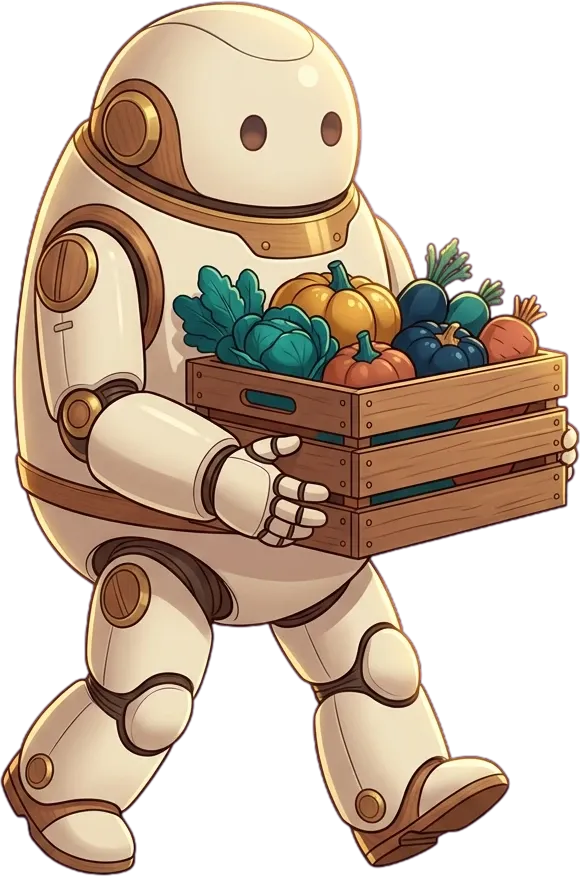
- An embodied companion: the same mind, in a robot body, in your home.
- Many machines you can call on for anything: any machine that’s free, called up for you by your companion. That’s machine labor on demand.
Through all three stages, one thing stays the same. You have a personal companion that carries your context and represents your computer and your digital mind.
That companion is your base personal machine, and it’s part of the floor: personal AI and personal machine labor, linked. Your computer becomes your robot, and your robot your computer.
A friend. A party member you go on quests with, first and foremost.
Other agents join along the way, mixed and matched like a party. But the companion comes first, and the companion answers to you.
This idea is older than the computer on your desk
None of this is new. What’s new is that it’s finally possible.
In 1945, Vannevar Bush described a machine he called the memex in his essay As We May Think, first published in The Atlantic.
He imagined “a future device for individual use,” where a person stores their books, records, and communications. He called it “an enlarged intimate supplement to his memory.”
Notice the words individual and intimate. The memex belonged to the person who used it.
In 1960, J.C.R. Licklider wrote Man-Computer Symbiosis.
He hoped that “human brains and computing machines will be coupled together very tightly,” and he was clear about the division of labor: “men will set the goals, formulate the hypotheses, determine the criteria, and perform the evaluations.” The machines would do “the routinizable work.”
In 1962, Douglas Engelbart wrote Augmenting Human Intellect. His goal wasn’t to replace the person. It was to build a world where the human “feel for a situation” could “usefully co-exist” with “high-powered electronic aids.”
In 1987, Apple made a concept video called the Knowledge Navigator, featuring a software butler in a bow tie who helps a professor run his day.
So the companion is an eighty-year-old dream that just got its hardware.
The question was never whether we’d get one. It was when, and when we do, who it answers to.
Memory is the whole game
What makes a companion a companion is that it knows you.
The AI companies have figured this out, and the hard part turns out to be memory itself.
A model works from one long window of text, its context: everything you’ve said, everything it’s read. In the standard design, the work of paying attention across that window grows with the square of its length. Twice the conversation means roughly four times the work.
And long before the window runs out, models start to slip. In 2025, researchers at Chroma tested 18 models and found that performance dropped as inputs grew, even on simple tasks.
So the labs have been teaching models to remember the way people do: keep what matters, and let the rest go.
The first trick is compaction. When a conversation nears the limit, the model summarizes what came before and keeps working from the summary. Claude Code has done it automatically since early 2025, and Anthropic opened server-side compaction to developers in February 2026. In November 2025, OpenAI trained GPT-5.1-Codex-Max to work across several context windows the same way.
The second is to stop cramming everything into the window at all. In October 2025, MIT’s Alex Zhang and Omar Khattab proposed Recursive Language Models. Instead of reading a huge input in one go, the model keeps it like a file in a small programming workspace, searches it, and calls itself on just the pieces it needs.
It works. In their paper, a small model set up this way handled inputs a hundred times longer than its window, and beat a much bigger model on a long-context test at about the same cost.
The third is dreaming. In May 2026, Anthropic gave its developer agents a feature it calls Dreams: between jobs, an agent rereads its memory and its past sessions, merges what’s duplicated, and replaces what’s gone stale.
A month later, OpenAI gave ChatGPT its own version, Dreaming. In the background, it rereads your past conversations and rewrites what ChatGPT knows about you.
None of this is abstract to me. This series was written across many long working sessions with Claude, and it only works because the model can compact, keep notes, and pick up where we left off.
The companion is already arriving.
It’s just arriving on someone else’s servers.
This is a problem. Because a companion that knows you is the most sensitive thing you’ll ever own.
It knows your health worries, your money problems, your fights with your family, and the ideas you haven’t told anyone yet.
And today, the rules about that memory are set by the company that holds it. A few examples from the last two years:
- Your chats aren’t privileged. In July 2025, OpenAI’s CEO Sam Altman pointed out that talking to a therapist, lawyer, or doctor comes with legal privilege, “and we haven’t figured that out yet for when you talk to ChatGPT.”
- Deleted doesn’t always mean deleted. In May 2025, a federal court in the New York Times copyright case ordered OpenAI to preserve ChatGPT output logs, including chats users had deleted. That obligation ended for new data in September 2025, but the logs already saved stayed saved. And with ChatGPT’s Dreaming, deleting a chat doesn’t delete the memories drawn from it. Those you have to delete separately.
- Local options can disappear. In March 2025, Amazon ended an Echo setting that let some users keep voice requests on the device instead of sending them to the cloud.
None of these companies is a villain. These are understandable decisions, made for ordinary business and legal reasons. That’s the point. If you create the incentives for these decisions to get made in this way, that’s how they’ll be made.
But if the intelligence you depend on lives on someone else’s servers, they decide what it will and won’t do for you, when it will and won’t be available to you, and they can change their minds at any time.
Plus, they’ll charge you for the privilege.
Star Wars saw this coming, too. At the end of Revenge of the Sith (2005), Senator Bail Organa takes charge of C-3PO and gives one order, according to the script: “Have the Protocol Droid’s mind wiped.”
C-3PO’s only line in reply: “Oh, no.”
Whoever owns the companion owns its memory. I want that to be you.
Local by default, cloud on request
Here’s the rule I’d build every companion around. Local by default. The cloud on request, when you actually need more than your machine can do.
It’s the same logic as the microgrid in Part 5: Every Town Can Own Its Own Power Plant and Chip Fab: a local network that usually runs connected to the wider grid, and can cut loose and keep the lights on when the grid goes down.
In 2026, this is mostly a question of how good, not whether.
On phones. Google’s Gemma 3n, released in June 2025, runs with as little as 2 to 3 GB of memory. Its successor, Gemma 4, released in April 2026 under an open license, includes models that Google says “run completely offline” on phones and even a Raspberry Pi.
On laptops. OpenAI’s open-weight gpt-oss-20b, released in August 2025, runs within 16 GB of memory, which is a normal laptop.
Built into the operating system. Apple ships an on-device model of about 3 billion parameters and, since 2025, lets developers call it directly. At its June 2026 developer conference, Apple added a new framework for running other models locally on Apple silicon.
In the chips. Apple’s M5 (October 2025) puts a Neural Accelerator in every GPU core, pitched for “running large language models locally.” Microsoft’s Copilot+ PCs are built around a neural processing unit (NPU) that does more than 40 trillion operations per second.
In memory you can read. Open source is working on the other half: memory you own. In January 2026, a personal agent called OpenClaw went viral with a simple design. Its memory is a handful of plain text files on your own computer: a profile of you, long-term notes, and a diary for each day, all of which you can open and edit. Its docs put it plainly: “there is no hidden state.”
It was the right idea, early and rough. Within days, researchers found hundreds of malicious add-ons in its skill store, some built to steal passwords. Its creator joined OpenAI in February, and the project moved to a foundation.
In March, Nous Research released Hermes Agent, which takes the next step. It keeps a small, fixed-size memory of you, and when that fills up, the agent decides for itself what to merge and what to drop. Its docs say it “builds a deepening model of who you are across sessions.” It also writes down the skills it works out, so it doesn’t have to learn them twice.
The most capable models still live in data centers. A model that fits in your pocket is not as smart as one that fills a warehouse.
That’s fine. That’s what cloud on request is for.
Your companion should handle most of your life locally. When it needs more horsepower, it should ask you, call a bigger model, and bring the answer home without leaving your life behind.
Apple’s Private Cloud Compute, for example, promises that data is deleted once a request is answered, and that outside researchers can verify the claim. That’s the right shape, whoever builds it.
One more honest note: local isn’t automatically safe.
In 2024, Microsoft’s Recall feature, which saved snapshots of your screen on your own machine, drew a security backlash strong enough that Microsoft delayed it and made it opt-in. Owning your companion means owning its security, too.
A note on which companion
When I imagine the companion I’d want to own, I picture Claude, the AI model made by Anthropic. This draft was written with Claude’s help.
But this isn’t a pitch for Claude or any company. You can’t buy Claude and run it on your own computer today, which is exactly the problem. Whatever model you’d pick, the companion should run on your hardware, keep your context, and answer to you.
The brand doesn’t matter. The ownership does.
From laptop to legs
Stage two is the companion getting a body.
Personal AI comes first, and it’s part of the floor today. The general-purpose personal robot joins it gradually, in an evolution I think begins around 2025 to 2027, and either way, you own your personal machine.
In Part 2: If a Human Wants to Do a Job, a Machine Shouldn’t Take It, I wrote that intelligent bodies “could be robots you rent, or robots you own, or if we produce enough of them, surplus robots that can be deployed anywhere and everywhere at any given time for any given need.”
So where are we, as of October 2026? Let’s be precise about what’s shipping versus what’s announced.
- 1X NEO. 1X opened pre-orders in October 2025: $20,000 to buy, or $499 a month, with US deliveries planned for 2026. Production started in Hayward, California, in spring 2026, with early units going to internal testing. In September 2026, its CEO said the factory won’t reach 10,000 units this year and set a target of 50,000 shipments in 2027. As I write this, I couldn’t find independent confirmation of NEOs working in paying customers’ homes.
- Figure 03. Figure unveiled its third-generation humanoid in October 2025, designed for the home, with soft textiles and washable covers. It hasn’t announced a date for selling it to households.
- Tesla Optimus. In its Q2 2026 update, Tesla said it was installing its first Optimus production lines at its Fremont factory, and that the first builds would go to its “Optimus Academy for training data collection.” Not to customers.
So home humanoids are announced, priced, and in production, but not yet in homes at scale.
That gives us a little time to get ownership right, and it matters even more here than on a laptop. NEO has a feature called Expert Mode: when it doesn’t know a chore, you can schedule a 1X employee to guide it remotely.
When the Wall Street Journal‘s Joanna Stern tried it, the robot wasn’t doing tasks on its own during her demo; an operator in a VR headset was driving.
1X offers privacy controls, like blurring people and keeping the robot out of certain rooms. But its CEO put the trade-off plainly: “If we don’t have your data, we can’t make the product better.”
I don’t blame them. That’s how you train a robot today.
But think about what that means. A body with cameras, walking around your home, learning your routines, sometimes driven by a stranger.
That’s the strongest argument I know for ownership. The robot in your home has to answer to you, run locally by default, and let a remote operator in only when you open the door.
Half droid, half server rack
So what does the finished companion look like?
I picture a mix of C-3PO, R2-D2, and an NVIDIA server rack.
A humanoid body that doubles as your personal agent. It follows you around, helps you get things done, and keeps a running log of your preferences and every skill you teach it.
It keeps a database for you, too, remembering what you want remembered. That’s the memex, eighty years on: “an enlarged intimate supplement to” your memory, and yours.
None of this exists yet. Getting there takes two fusions.
First, the personal agent has to fuse with the computer you own. Today’s agents live in the cloud, while the computer on your desk mostly sits there.
Then the computer you own has to fuse with the robot.
Even then, I’d keep a home server: a small machine where the hard copies of your important information live. NVIDIA already sells a desktop AI computer, the DGX Spark, for about $4,700.
Your robot should be able to log into that server securely, the way engineers reach a remote machine over SSH, any time and from anywhere.
Picture it as a micro-cloud. Most of the thinking happens at the edge, on the robot’s own computer, while it works. What it learns gets logged back to the home server later.
And when you, your robot, or your server need more horsepower than you own, any of you can call a bigger run from the wider network of compute that’s available on demand.
It’s the microgrid from Part 5 again, this time for intelligence: local first, always connected, and able to cut loose and keep running.
Build the party
Once you have a companion, the rest of the party forms around it.
Remember the roles from Part 4: “You have a healer. A damage dealer. A tank. A support.”
The companion is the party member who knows you. Everyone else joins for the quest:
- You. The leader. You pick the quest.
- Your companion. Carries your context and speaks for your computer and your digital mind.
- Specialists. Agents trained for one craft, like law, medicine, or carpentry, many of them trained by the guilds I described in Part 4. They join for a job and then leave.
- The fleet. Machine labor on demand, called up for the heavy lifting. In Part 5, I argued that you hold what you use: your town’s trust holds the machines that make the essentials, guilds and parties hold what their work needs, and any machine sitting idle is free to call.
- Other humans. The people you actually want on the quest. As I put it in Part 4: “Not who you need; who you want. Who you like.”
That gives us a clean ownership map:
- You own your companion, your personal AI and the personal machine labor linked to it.
- Your town’s trust holds the machines that make everyone’s essentials.
- Guilds train and steward the specialists, and own their craft’s tools.
- Parties form, finish the quest, keep what they build, and disband.
- Every machine not in use is free to call.
Pokémon already works a lot like this. You have your party, the partners you raised.
But since Sun and Moon, you can also use a Poké Ride pager to summon a specialist when you need one, use it, and send it back. I dig into that in Part 13: Pokémon Already Showed Us How Machine Labor Should Work.
Your companion makes the call to the fleet. You say what you want, and your party member handles the rest.
Never tell me the odds
Now for the part that matters most.
You wouldn’t want a whole party of C-3POs.
A party of C-3POs would calculate the odds of every quest, list every danger, and talk itself out of all of them. It would never enter the asteroid field.
In Part 4, I wrote that “If you don’t want to work with other humans in your party, for example if you think they all stink at their role, then you could work with a party full of machines.”
Then I added: “I find this outcome unlikely in every scenario, but it’s possible.”
This is why I find it unlikely. Machines are great at the odds. They aren’t the ones who should decide what the odds are worth.
That’s the human-will rule, applied to decisions: if a human wants to do it, a human gets to do it. And that includes the most important job of all, making the final call.
Chess tested this. In 1998, a year after losing to Deep Blue, Garry Kasparov launched Advanced Chess in León, Spain, where each player had a computer at the board. Players later nicknamed these human-machine teams “centaurs.”
In a 2005 freestyle tournament, the winners were two amateurs running three computers at once. Kasparov drew the lesson in a 2010 essay: “Weak human + machine + better process was superior to a strong computer alone and, more remarkably, superior to a strong human + machine + inferior process.”
The process is the point. And the process I want puts the person in the pilot’s seat.
In 1997, the computer scientists Ben Shneiderman and Pattie Maes held a famous debate about exactly this. Maes argued that as our workload grows, “There is no other solution than to delegate.”
Shneiderman argued for control: users, he said, “want to have the feeling they did the job,” not some “magical agent.”
I think they were both right. Delegate the work. Keep the will.
Here’s a practical version. Your companion should always be able to tell you the odds. But how often it tells you should be your setting, not its.
Some days you want the full risk report. Some days you want to hear the number once, and then fly.
Han didn’t ignore C-3PO. He heard him, and chose.
Fortress or forest
There’s a safety question here. If billions of people each own a capable AI, isn’t that harder to control than a few AIs in a few data centers?
Yes. That’s the trade.
Think of it as a fortress or a forest. A fortress is safe through control: one wall, one gate, one off-switch.
A forest is safe through many roots: no single fire takes the whole thing down. Centralized AI is the fortress. Personal companions are the forest.
The forest is harder to oversee. But it’s much harder to capture, because nobody owns the off-switch, and nobody owns the surveillance either.
In July 2024, the US government’s National Telecommunications and Information Administration concluded that the evidence wasn’t sufficient to justify restricting open-weight models, and recommended monitoring the risks instead.
Don’t burn the forest down. Keep watching for fire.
And forests still have rules. A companion that answers to you shouldn’t help you hurt someone else, any more than a good friend would.
Pokémon has an episode about this. In ”Dig Those Diglett!” (1997), hired trainers’ Pokémon refuse to clear the Diglett off a dam site, because the dam would flood their home. The foreman cancels the project.
That’s the kind of loyalty I want from a companion. Loyal to me. Not loyal against everyone else.
Objections
Won’t my companion just be a company’s spy?
If you rent it, it might be. That’s the whole reason to own it.
An owned companion runs locally by default, keeps its memory on your device, calls the cloud only when you say so, and lets you take your memory with you if you switch. A robot companion lets remote operators in only when you invite them, the way you’d let a plumber in.
And the law has to catch up. Altman himself said we should have “the same concept of privacy for your conversations with AI that we do with a therapist.”
I agree, and I’d go further: the strongest version of that privilege is a companion that never sent the conversation anywhere to begin with.
What happens when it’s smarter than me?
In some ways, it already is. C-3PO was, in his own words from the script, “fluent in six million forms of communication.” Han wasn’t.
But smarter doesn’t make it the boss. We all have friends who are smarter than us at something.
We don’t hand them our lives. We ask their advice.
A good companion should make you smarter, too. That was Engelbart’s whole point: augment the person.
In Part 4, I pictured machine guild members teaching beginners “with all their infinite patience and infinite time.” Your companion can be that teacher.
Why keep humans in charge if the machine is better at the odds?
This is the hardest one, so let me be honest about the evidence.
In 2024, researchers at MIT published a meta-analysis of 106 experiments on humans working with AI. On average, human-AI teams did worse than the best of humans or AI alone.
The losses showed up in decision tasks, especially when the AI was already better than the human. The gains showed up in creative tasks, and when the human was better than the AI.
So for a pure calculation, where there’s one right answer and the machine is better at finding it, let the machine calculate. Don’t second-guess the autopilot’s math.
But most of the choices that matter in a life aren’t calculations. Which quest to go on. What risk is worth it. Who to bring along.
Those are questions about what you value, and there’s no odds table for that.
The odds are an input. The will is the decision.
That’s the world we want: one that’s maximally free and maximally safe, where you get the best information in the galaxy and still get to choose.
Your first party member
Here’s the short version.
The companion is an old dream: Bush’s memex, Licklider’s symbiosis, Engelbart’s augmentation. In 2026, it’s finally possible, on our phones and laptops today and in robot bodies soon.
The only question left is who it answers to.
I think it should answer to you. Local by default, cloud on request. Your hardware, your context, your memory.
A friend that tells you the odds when you want them, and then gets in the ship anyway.
Everyone gets a first party member. Then you go find your quest.
And if you want to see a world that’s been running this experiment for thirty years, where every kid leaves home with one partner and help on call, read Part 13: Pokémon Already Showed Us How Machine Labor Should Work.

The companion, in three stages
Same mind, more hands
You
● Carries your context. Answers to you.
A model you buy and own, running on your own computer.
Who holds the memory?
Local by default, cloud on request
Their rules
- Your chats aren’t privileged.
- Deleted doesn’t always mean deleted.
- Local options can disappear.
Your companion should handle most of your life locally.
Never tell me the odds
It tells you the odds. You make the call.
≈ 3,720 to 1
⚙ Your companionCalculates, translates, worries
♥ YouPicks the quest. Decides what the odds are worth.
The odds are an input. The will is the decision.
Futurespective
The AI industry has had years to tell you what’s in it for you. They failed. Here’s my attempt...
New essays from Futurespective, in your inbox.