
Emad Mostaque and I Agree on the Destination, Not the Road
We both think checks fail, corporations fade and machines should belong to the places they work, but we split on what the floor is made of, how big the owner should be, and whether you can sell it.
“Your economic life expectancy is shrinking. Not your career.
Not your current job. Your entire economic relevance as a human being.”
That’s the first line of The Last Economy, a book by Emad Mostaque, co-founder of Stability AI (the company behind Stable Diffusion) and founder of the Intelligent Internet. He published it in August 2025, and it’s free to read online, every word.
The book’s clock is a thousand days. Counted from publication, that runs out in May 2028. As I write this, there are about 590 days left.
I read the whole thing, plus his whitepaper, newer papers and several interviews. It’s the closest thing to The World We Want I’ve found from someone who has actually shipped frontier AI.
Part 22 was my letter to the AI industry. His book reads like an answer from inside it.
Mostaque is a contested figure. Forbes questioned some of his claims while he ran Stability AI, which he disputed. I’m engaging with his ideas here, not his résumé.
In The AI Industry Has Never Told You What’s In It for You, I complained that the industry sells the machine and never tells you what changes for you. Mostaque is trying to answer that question.
Here’s my short version: we agree on the destination, not the road.
What the book says
Mostaque’s diagnosis comes in a few memorable phrases.
The Intelligence Inversion. Value has inverted four times: land, then labor, then capital, and now intelligence. “We are living through the fourth and final inversion right now,” he writes in Chapter 1.
The Metabolic Rift. Humans need food and shelter.
“AI and robotics are non-metabolic labor. They require only electricity.” So on price, we lose.
For a growing majority of cognitive tasks, he argues, the economic value of a human “is not just lower than an AI. It is negative.”
The Abundance Trap. Our economy is built to manage scarcity, so it reads abundance as failure.
In his words, our “scarcity-based economic system is going to process this abundance as poverty.” Free AI tutoring shows up on the dashboard as a collapsing education sector.
Three Futures. From there, he sees three stable outcomes:
- Digital Feudalism: a few companies own the AI.
- The Great Fragmentation: every nation walls off its own.
- Human Symbiosis: the one he wants.
His fixes have names too:
- Universal Access to Intelligence: a personal AI agent for everyone, plus a daily quota of compute.
- Two currencies: one for atoms, one for bits.
- The Symbiotic State: a government that acts as a gardener.
- “Nucleation”: small places that prove the model first, until everyone copies them.
The book reaches for a lot of physics (entropy, phase transitions, the mathematics of flows). Some of that is metaphor doing the work of proof. But the economic argument underneath is clear, and much of it is right.
Where we agree
Checks are a dead end
In Part 6: UBI Won’t Work. Universal Basic Goods Will., I wrote that “A check only works if there’s enough of the things it buys, and making enough is exactly the problem machine labor should solve.”
His first future, Digital Feudalism, is the one where “Everyone else lives on universal basic income, enough to survive, not enough to matter.”
In Chapter 5, he argues that the owners of the AI will fight the taxes needed to fund a real UBI, so “The likely result is not a liberating dividend, but a subsistence level pacification tool.”
And on a podcast in September 2025, he put the money problem bluntly: “UBI doesn’t work with tax because, in fact, the tax base will come down.”
I argued that a check gets eaten by prices. He argues that a check gets starved by politics. Both of those are true.
The corporation is finished as a way to organize people
In Part 4: Quests Should Replace Corporations, I argued that once companies can hire machines, they stop being good homes for people.
Mostaque, in Chapter 11: “The traditional firm, a hierarchical pyramid of human components, is an evolutionary dead end.” He thinks what replaces it is “a community,” like Linux or Wikipedia.
He even points to the same moment I did in Part 7: the East India Company’s charter in 1600. He calls it our “first, slow, mechanical attempt at artificial intelligence” (Chapter 20).
Build the prototype, not the revolution
My favorite line in Part 7 is the practical one: “You can’t predict shocks on a schedule, but you can have prototypes ready for when they come.”
Mostaque’s version, from Chapter 16: “Our strategy must be to create the Florences of the 21st century.” He calls them small, protected “Symbiotic Zones” that win by example.
He sums it up: “The question is not ‘How can we save the world?' The question is ‘Where do we build the first seed?'”
Same theory of change. Nobody votes in a new economic system. Somebody builds one that works, and everyone copies it.
Machines should belong to the places they work
This is the agreement that surprised me most.
In September 2026, Mostaque published a short essay called The Intelligence Age Must Be Built Right. It introduces what he calls Champions.
“A Champion is a private company with a public-benefit purpose, founded and majority owned by people and institutions from the place it serves. We believe intelligence should become a utility…”
One of a Champion’s three jobs is “Humanoids as a service.” His reasoning: “A machine can be made anywhere, but it works somewhere.”
His team’s paper on robots, Intelligent Machines, goes further. “The durable answer is that the displaced are also the owners and the provisioned.” Its picture of success is a care-home robot “that frees the carer rather than replacing her.”
Compare that with my design in Part 5: Every Town Can Own Its Own Power Plant and Chip Fab: the machines that make the essentials belong to a place, every idle machine is free to call, and people organize into parties and guilds that call on the machines’ time.
We both landed on machine labor as a locally owned utility. I think that’s the most important idea either of us has.
Humans keep the last word
In Chapter 15, Mostaque splits the work: “AI is the Action Layer… Humanity is the Alignment Layer.”
In Chapter 17, he imagines a governing council made of “a randomly selected jury of citizens: a nurse from Ohio, a farmer from Iowa, a programmer from California.” His summary is “The algorithm proposes; humanity disposes.”
He also gets the instinct behind my human-will rule. “I’m not gonna go to a concert done by robots,” he said on the same podcast. “I prefer to go to a concert with people.”
Where we differ
Here’s where the roads split. I count seven forks.
1. What the floor is made of
Mostaque’s floor is intelligence and money.
The core promise of his new social contract, in Chapter 14, is that “The Symbiotic State guarantees every sovereign agent a daily quota of computation and access to foundational AI models.”
Every human also gets “a personal AI agent, cryptographically bound to you alone.”
On top of that, his second currency, Culture Credits, is “issued as an Abundance Dividend” to everyone (Chapter 18). On the podcast he floated “a version of cash against this gold that basically you got for being human.”
My floor is the things themselves: food, water, energy, housing, healthcare, transport and communication.
To be fair to him, a personal agent is a powerful tool, and he’d say it’s the tool that gets you everything else. I’ve added it to my own list, linked with personal machine labor. But you can’t eat an agent, and you can’t live in one.
And notice that the Abundance Dividend is a check. It’s in a new currency, and it isn’t funded by taxes, which answers his own political objection. It still runs into mine: if the supply of housing doesn’t grow, more money chases the same homes.
His newer work is moving toward physical goods. But the book spends far more pages on cognition than on rent.
2. What money should be
Mostaque proposes two currencies for “two different physical realities.”
Foundation Coins are for the world of scarce atoms. They’re minted only when a network can verify “useful computation has been performed for the open intelligence commons.”
And “Its supply is capped, ensuring it remains scarce and resistant to inflation.” His Champions thesis calls it “a variant of Bitcoin,” capped at 21 million coins.
Culture Credits are for the world of abundant bits. They lose value if you hoard them, an idea called demurrage.
The originator is the economist Silvio Gesell, in The Natural Economic Order (1916). The Austrian town of Wörgl famously tried it in 1932, until the national bank shut it down in 1933.
I like demurrage. Money that rots if you sit on it is money that circulates. But I see two tensions.
The first is in his own chapter. He criticizes Bitcoin because “Its deflationary nature incentivizes hoarding over circulation.” Then he proposes a hard-capped, Bitcoin-like coin as the money for the world of scarce physical things.
He’d answer that the reserve is meant to be held and the Credits are meant to be spent. Fair. But the things people need most, like land, food and housing, live in that scarce world.
The second is measurement. Foundation Coins get minted for verified “benefit,” and someone has to define benefit.
In Chapter 4, Mostaque himself quotes Goodhart’s law (Charles Goodhart, 1975): “When a measure becomes a target, it ceases to be a good measure.” Minting money against a benefit score is about as strong a target as you can build.
My answer is simpler, and maybe less elegant. Make the essentials free, so there’s nothing to price. Keep money for what’s scarce by nature: the beachfront, the original painting, “the attention of one particular person.”
3. How big the owner should be
His Champions thesis calls for “One Champion per jurisdiction,” meaning “A US state, or the appropriate country or region elsewhere.”
The Champion page puts it more boldly: “Every nation will run on AI. The question is who owns it.” And: “The cap table is the country.”
My owner is a town. Each town’s trust owns the power, water and robots that make its essentials, guilds own their craft’s tools, and parties own what they build. Bigger infrastructure belongs jointly to the town trusts that use it, the way American electric cooperatives formed bigger co-ops to generate and carry their power.
A state is a lot better than three labs. But a state like California has tens of millions of residents. Ownership spread that thin feels a lot like owning a share of a public company: real, but distant.
His own book argues my side here. His “Law of Resilience” (Chapter 7) says diversity beats monoculture. His favorite network shape, the “distributed mesh,” is “the topology of communities, not corporations” (Chapter 10).
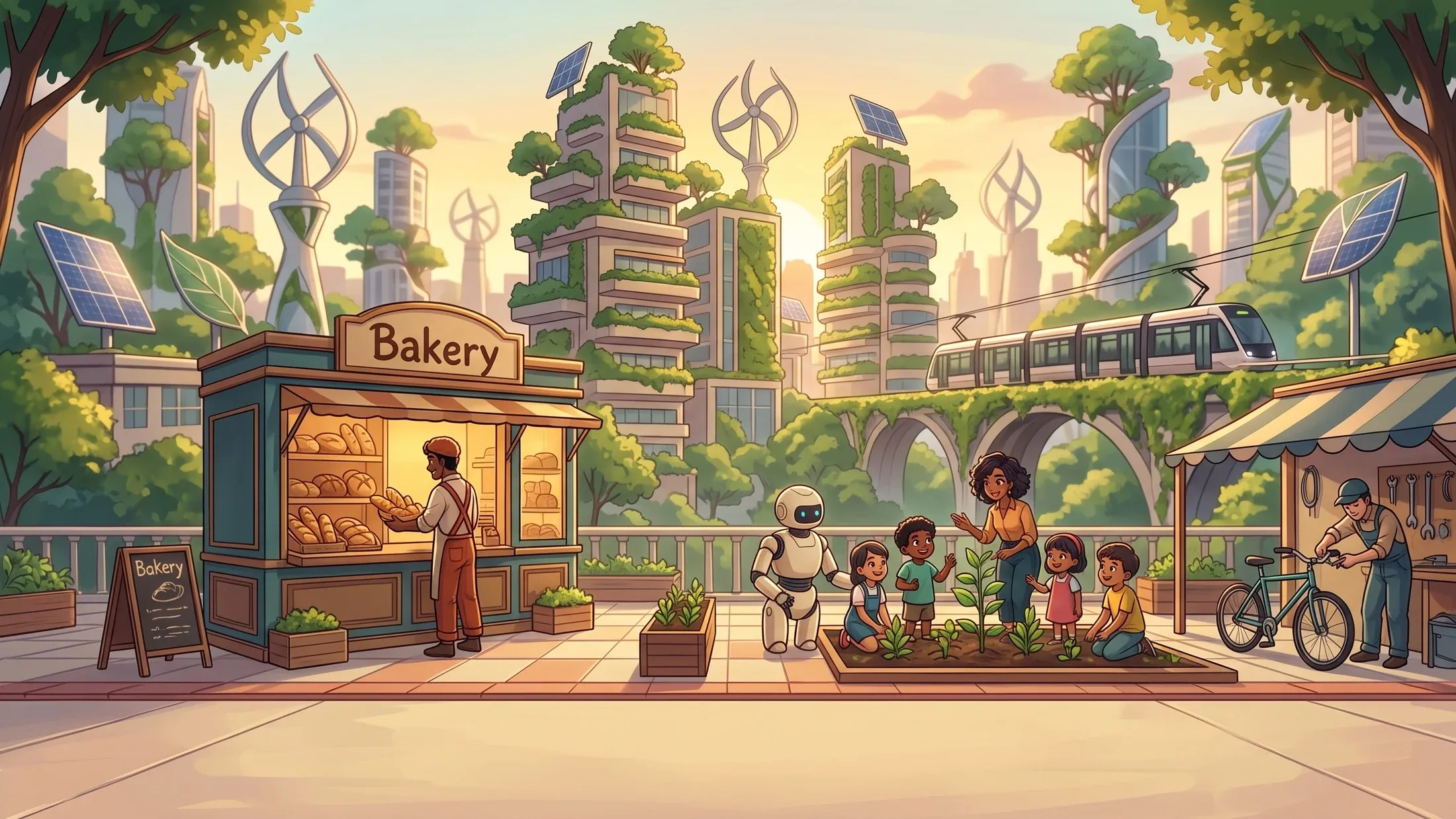
That’s my fortress vs forest point. One Champion per state is a few dozen fortresses. A trust in every town is a forest.
4. Whether you can sell it
This is the fork I care about most.
A Champion is a company with shares, and the founding plan is generous to locals:
- The first round is reserved for local people and institutions “at a nominal company valuation of one dollar.”
- Outside money in the second round is capped at what locals put in.
- A trust holds equity for local children, with “a further 0.5% allocated annually for newborn cohorts.”
Then: “As soon as practical, the aim is to list each Champion on public markets without displacing local majority ownership.”
My trusts, which I lay out in Part 5, work differently:
- Membership comes with residency, and it’s your universal basic capital share.
- One person, one vote.
- No one can sell it, though it moves with you when you move.
As I argued in Part 5, capture usually happens one of two ways: someone buys control, or control concentrates in a few hands. Listed shares open the first door.
Shares weighted by what you put in open the second. A rule that keeps a local majority on day one is a promise, and promises tend to fade over decades of trading.
There’s also the builder’s cut. Under the thesis, Intelligent Internet takes “10% founding equity” in every Champion, with no end date that I could find. My gift-back caps the builder’s return, then hands the infrastructure to the community.
5. What humans are for
Mostaque thinks the market value of human work is going negative, and his newer Intelligent Economics paper argues that the usual rescue (comparative advantage) “does not make a negative-surplus agent profitable.”
So in his world, people move to what he calls the “Arts of Being Human”: attention, connection, meaning-making and what he calls embodiment.
His most vivid scene is a CEO who commands a swarm of AI agents and then realizes she has become “a ceremonial button-pusher for an engine that no longer needs a driver.”
I agree with the economics. A corporation won’t keep you if a machine is cheaper. That’s exactly why I think the human-will rule has to sit outside the market, as a rule we choose: “if a human wants to do something, a human gets to do it.”
My rule covers any work, not just the meaningful-sounding kinds. Want to build the chair?
Build the chair. Want to farm, code, cook or fix the robot? You’re first in line.
Mostaque has “Reality Anchors,” the “farmers who know the soil, the craftspeople who understand materials.” I’d say: don’t make them a category. Make it everyone’s right.
And there’s a wobble in his own system. In the book, his governing council is a citizen jury.
In his whitepaper, “Each Council seat is itself a Partner-grade II-Agent,” and “Human overseers still sign the final transaction.” That’s a human approving, not a human deciding. I’d hold him to the book’s version.
6. Who pays for the transition
Mostaque is skeptical of taxing his way through. In Chapter 17, he says that taxing intangible capital “is like trying to build a dam on a cloud.”
His funding engine is the coin itself: sell Foundation Coins, use the proceeds for compute, and let governments catch up later.
In my first tax sketch, now in Every Spending Bill Should Show Up on Your Paycheck, I went the other way:
- A decade of one flat rate with no loopholes.
- Reinvest the growth in community funds.
- Shift the tax base to things that can’t flee: land, natural resources and permits for scarce compute.
That piece has since swapped the flat rate for one formula, with capital paying more than wages, and leaves land to states and cities. The direction is the same.
He’s right that profits flow through clouds. But data centers don’t.
They sit on land, draw power and need water. Tax the ground and the grid, and the cloud has to come down to pay.
7. How fast
Mostaque’s clock is short. In a November 2025 interview, he clarified that the thousand days are “not about irreversibility, alignment, it’s more about your economic value.”
Within “900 days or so,” he said, “any job you can do on the other side of a screen, an AI will be able to do better.” A year after publishing, his team wrote that “If anything, the Thousand-Day Window is shorter than it was when we started counting” (One Year On).
My clock is a decade for the new system to take shape, then deployment into the 2040s. In Chapter 13, he argues that AI breaks the economist Carlota Perez’s pattern of a long, stable “deployment period” after each technological revolution. Part 7 leans on that pattern.
I think we’re both right, about different things. Screens move at the speed of bits. Homes, farms and power plants move at the speed of atoms.
His team’s robot paper says hand skills fall last. Screen work may stop paying by 2028, but the floor still has to be built.
What I’m taking from him
Steelmanning someone should change your mind about something. Here’s what he changed in mine.
- Start ownership on day one. My gift-back asks builders to hand over infrastructure later. His Champion gives locals ownership at the founding, at a one-dollar valuation, and caps outside money. That fixes the hardest objection to my plan: why would a builder ever give it back? Answer: don’t wait for them to. Write local ownership in from the first contract, as a trust that can’t be sold.
- Give children a stake at birth. A slice set aside for every newborn is the most “floor for everyone” idea in either of our plans. Trusts should copy it.
- Put a personal agent on the floor. Universal basic goods and services should include universal basic intelligence: an agent you own, local first. I’ve adopted this one: personal AI, linked with personal machine labor, is part of my floor now. I made the case in Your First Party Member Should Be an AI You Own.
- Measure the right things. His MIND dashboard (material, intelligence, network and diversity capital) is a better scoreboard than GDP. The signposts in Plan for the Bad Transition should borrow from it.
- Keep the work where the machine works. His team’s rule that remote robot piloting is “performed in-jurisdiction” (Intelligent Machines) keeps jobs and data local during the transition.
Where he’d push back on me
Fair is fair. Here’s how I think he’d answer this piece, and how I’d answer him.
“You’re too slow. The window is a thousand days, not a decade.”
For screen work, he’s probably right, and I should say so more loudly. But speed is exactly why the floor matters. If people lose cognitive jobs by 2028, the safest thing we can do is start building the goods now, rather than count on a new currency to buy them.
“Your guilds are artisanal cheese.”
He wrote it himself: “You cannot run an economy for eight billion people on artisanal cheese and life coaching.”
Agreed. In my world, guilds don’t have to run the economy. The floor is made by machines and is free.
Craft doesn’t have to pay the rent, so it doesn’t have to scale. That’s the whole point of the floor.
“A town is too small to bargain with a hyperscaler or finance a robot fleet.”
That’s his strongest point. A Champion’s power comes from pooling demand. My answer is federation.
Town trusts pool their buying the way rural co-ops pooled their power plants. Each town owns the machines that make its essentials. The federation holds the regional half of everyone’s share, and it does the bargaining.
“If your trusts can’t sell shares, who funds them?”
Builders do, under contract, with a capped return. And public investment does, through the community funds in Every Spending Bill Should Show Up on Your Paycheck.
His TSMC-style founding round is a third answer I’m happy to borrow, as long as what locals buy is a vote and a dividend, not something they can sell to a fund.
“Free goods without a stake leave people powerless.”
His exact words: “If production rises while fewer people are needed to produce it, access leaves the economic problem unresolved. People need a stake in the abundance intelligence creates.”
I agree, which is why the floor was never my whole answer. In Five Takes the AI Industry Needs to Ingest, I gave everyone three stakes instead of a job: a residency stake in their town’s trust, a craft stake in their guilds and a quest stake in their parties.
“You can’t tax a cloud.”
You can tax the land it sits on.
A steering wheel, and whose hands are on it
My brand for this series is Worldbuilders. Doomers want a brake. Accelerationists want a gas pedal. Worldbuilders want a steering wheel.
Emad Mostaque is a Worldbuilder. He saw the problem early, he gave his book away, and he’s building institutions rather than just warning about them. He ends his Champions essay this way: “We still have time to decide that, and to keep the last word.”
We agree on the destination: abundance, human agency and machines owned by the people who live alongside them.
We disagree about whose hands are on the wheel. He’d give it to a company owned by a state’s residents. I’d give it to a trust owned by a town’s residents, one vote each, that no one can buy.
His question is “Where do we build the first seed?”
My answer: in your town. And the piece of the floor we both agree on, a personal AI that belongs to you, is the one I made the case for in Your First Party Member Should Be an AI You Own.
Under all of this, his clock and mine are an argument about speed. The finale takes that argument to its extremes, slow, fast and deadly, in Part 24: Doom or Foom, the Answer Is the Same: Own the Machines.

Same destination, seven forks
Where the road splits
Where we agree
- Checks are a dead end
- The corporation is finished
- Build the prototype
- Machines belong to places
- Humans keep the last word
The destination: Abundance, human agency, machines owned by the people who live alongside them
What the floor is made of
MostaqueIntelligence and money: a daily compute quota, a personal agent, and an Abundance Dividend
MeThe things themselves: the seven essentials, plus personal AI and machine labor
Fortress or forest
One big owner, or a trust in every town
Listed shares open the first door.

Two clocks
A thousand days for screens. A decade for the floor.
His clockScreen work, the thousand-day windowabout 1,000 days left
My clockThe new system takes shape, then deploysnot started
Drag through time Aug 2025
Futurespective
The AI industry has had years to tell you what’s in it for you. They failed. Here’s my attempt...
New essays from Futurespective, in your inbox.