The whole idea, at the depth you want
What should life look like once machines can do almost any job? My answer has a name, Universal Basic Everything: the essentials free for everyone, an equal share of the machines that make them, and first pick of any work you want to do. Pick how much time you have.
- 2 minutesWatch the filmOne animated short: what the AI companies promise and leave out, why freedom and safety go together, and how we’d build a world where you do the work you choose and machines cover the rest.
- 15 minutesRead the explainerHow the whole idea fits together, one ordinary Tuesday in a made-up town, and the eight words you’ll run into most. Or watch four short films instead.
- About an hourRead the core pathThe five essays that explain the whole idea, in order, each with a one-minute summary first.
Want everything? There are 25 essays in three books, about 6½ hours of reading, or 24 short films that run about 85 minutes in all. Browse all the essays →
2 minutes
The World We Want, in two minutes
Read the narration
- 0:00 Every AI company is promising us a future of abundance.
- 0:05 Machines that can do anything. An intelligence explosion. Everyone gets rich.
- 0:10 And none of them can tell you what your Tuesday looks like.
- 0:13 If it plays out their way, they’ll own everything... and we’ll live on whatever pennies they hand us.
- 0:20 So let’s imagine the future we actually want.
- 0:23 A world where you can do anything you choose.
- 0:26 Not what someone will pay you to do. Not what society asks of you. What you choose.
- 0:31 That takes two things we usually treat as opposites: freedom... and safety.
- 0:35 But really, they’re twins. To be free, you have to be safe.
- 0:39 So let’s build that world... backwards.
- 0:42 First: we need thinking machines and working robots, on call like the power grid, flexing up and down to meet demand.
- 0:50 Second: aim them at everything scarce. Food. Homes. Healthcare. Energy. Until there’s enough for everyone.
- 0:57 Not a basic-income check that rising prices swallow. The things themselves.
- 1:03 Third: once machines carry the load, the corporation doesn’t have to be the center of our lives.
- 1:09 Instead, we form parties: single-use companies, built around one quest, that disband when it’s done.
- 1:14 And we join guilds: people who share a craft and want to master it together, teaching it to people and machines alike.
- 1:22 You do the work you want to do, for the people around you.
- 1:25 And whatever’s left undone, the work nobody wants to do, the machines flex up to cover.
- 1:30 That’s what safety really means: the base of the pyramid, food, shelter, health, simply taken care of.
- 1:38 So everyone gets to climb higher. To belonging. To growth. To purpose.
- 1:44 And up there, we pursue the two things AI can’t automate: curiosity... and caring for each other.
- 1:51 You’re free... because you’re safe.
- 1:57 Oh, and P.S., AI companies? Feel free to start building this for us. We know you’re going to steal the idea anyway.
15 minutes
The idea in fifteen minutes
My answer is Universal Basic Everything: three universal pieces and one rule, and the rule comes first. If a human wants to do something, a human gets to do it, and machines fill whatever is left.
It starts with ownership. Once machines can do most of the work, whoever owns the machines decides who benefits from them. So everyone owns them together, in equal shares that can’t be sold, and the gains flow to all of us instead of a few.
Then come the machines themselves: enough intelligent robots to do any job, on call for everyone. You get a personal machine of your own, plus the same right as everyone else to call on any machine nobody’s using. Together they make the floor: a reasonable week of the goods and services every person and family needs, including the things we do for fun, free, with about 20% headroom on top. Beyond those essentials, we use money to coordinate excess demand.
With the floor under you, the rest of your time is yours. That’s the frontier: baking bread, restoring a creek, teaming up with friends on the kind of project you’d start a company for today, or learning a craft from people who love it. Whatever you choose, the rule holds. If you want to do the work, it’s yours, and machines cover whatever’s left.


The frontierWhat you choose to do
Above the floor, you choose how to organize yourself and spend your time: form parties for completing shared goals, join guilds for learning shared crafts, participate in leagues for the love of the game, and use markets to coordinate only what stays scarce.
- Parties for goals
- Guilds for crafts
- Leagues for the game
- Markets for the scarce
The floorUniversal basic goods and services
The floor is a reasonable week’s worth of the goods and services a typical person or family uses, free, with about 20% headroom on top. Beyond those essentials, we use money to coordinate excess demand.
- Groceries
- Power and water
- Getting around
- Staying connected
- Seeing a doctor
- A home
- Everyday fun
The ownershipUniversal basic capital
Everyone owns the machines together, in equal shares, so the gains flow to all of us instead of a few. And since anyone can call on the machines nobody’s using, you can pool your time and machine hours with others, like a venture team, and go after the projects you care about, in your town or far beyond it.
Getting there
- NowStrengthen the safety net, and write the rest into lawStart with help people need today: unemployment insurance that covers gig and contract workers, a monthly tax credit for low-wage workers, and paid apprenticeships. The next two steps are passed now too, each with a trigger in the data that switches it on, so help never has to wait for a vote in the middle of a crisis.
- If wages fallThe cash floor jumps to full sizeIf pay starts falling across the economy, everyone’s monthly cash floor goes straight to its full size: $4,800 a year for each adult and $1,700 for each child. The tax system takes it back as income rises, so most of it reaches the people whose paychecks shrank.
- As machines take overBuild each town’s machines, then hand them overIf machines take over so much work that workers’ share of income keeps falling, the public’s cut of AI profits goes into funds that build each town’s own power, water and machines. Once they’re running, they’re handed to the people who live there, one equal share each.
Each piece, and what it does
The ownershipUniversal basic capital
Everyone owns the machines together, in equal shares, so the gains flow to all of us instead of a few. And since anyone can call on the machines nobody’s using, you can pool your time and machine hours with others, like a venture team, and go after the projects you care about, in your town or far beyond it.
Whoever owns the machines decides who benefits from them, so everyone owns them equally. Half of your share sits in your town’s trust, a co-op like the ones that still own the power lines in many rural towns, which holds the local machines and gives you one vote on how they’re used. The other half sits in a federation of town trusts across the region, so one flood can’t wipe out a town’s stake. And nobody can sell their share, so nobody can buy up the machines.
The powerUniversal basic machine labor
Machine labor on demand: enough intelligent robots to do any job, anywhere, at any time, built to flex up or down with demand. Everyone gets a personal machine of their own, plus an equal right to call on any idle one.
The machines are AI joined with robot bodies, and they do the work. Your personal machine is yours to use, and you can lend it out when you don’t need it. Beyond that, you have the same right as everyone else, simply as a person, to call on any machine nobody’s using. When lots of people ask at once, essentials like water and food go first, then projects your town voted for, then everyone’s own projects, which always keep a share of the machines saved for them.
The floorUniversal basic goods and services
The floor is a reasonable week’s worth of the goods and services a typical person or family uses, free, with about 20% headroom on top. Beyond those essentials, we use money to coordinate excess demand.
Everyone gets the essentials themselves, not a check to buy them, because a check only works when there’s enough of what it buys. Hand everyone more money for rent, and rents just rise to meet it. The amount isn’t a fixed list of rations. It’s a normal week of groceries, power, water, getting around, staying connected, seeing a doctor and the things we do for fun, plus about 20% headroom, and only use past that has a price.
The frontierWhat you choose to do
Above the floor, you choose how to organize yourself and spend your time: form parties for completing shared goals, join guilds for learning shared crafts, participate in leagues for the love of the game, and use markets to coordinate only what stays scarce.
Once the essentials are covered, work becomes something you pick. A party is a small group that forms for one goal, like restoring a creek or making a film, and breaks up when it’s done, so what you’d start a startup for today becomes a party tomorrow. A guild gathers people who share a craft, like baking or beekeeping, to teach it and get better at it together. Money still sorts out what stays scarce, like a beachfront house or an original painting.
The ruleOver all three
If a human wants to do it, a human gets to do it. Machines fill whatever is left.
People get first pick of any work, from baking bread to building a bridge, and machines take the jobs nobody chooses, so the bread still gets baked on the mornings nobody signs up. It’s a right to do the work, not a promise of a wage, because the floor already covers your living.
The second ledgerResource accounts
To coordinate abundant resources, each town keeps a digital, always-current record of what it physically has and needs, so surplus can flow quickly to wherever it’s short. It works the way the power grid’s market already moves electricity to wherever it’s needed, minute by minute, but for absolutely everything.
A price can’t tell you an aquifer is running low or a machine is wearing out. So every town keeps a live count of what it physically has, makes, uses and loses, read straight from meters and scales: megawatt-hours of power, gallons of water, tonnes of grain. When one town has spare grain and its neighbor has spare solar power, they trade, and only the difference is settled in dollars.
Getting thereThe transition
Strengthen the safety net now, raise everyone’s monthly cash payment to full size if wages fall, and, as machines take over, build each town’s own machines and hand them to the people who live there.
Building the floor takes years, and a paycheck can vanish in three months. So each step is written into law ahead of time, with a clear number that switches it on, like wages falling for two quarters in a row, so help never waits on a vote. Taxes never make hiring a person cost more than buying a machine, and the whole design gets tested in pairs of towns before it spreads.
What “Universal Basic Everything” means, and the hard part
An ordinary Tuesday in Ridgeview
Picture an ordinary weekday in 2045 in Ridgeview, a farm-valley town of about 3,000 people. The town and everyone in it are made up, but almost every machine you’ll meet already exists somewhere today. Nothing special happens. People bake, fix a creek, pick up groceries and vote, and the whole system quietly runs underneath.
5:40 a.m.
The bakery
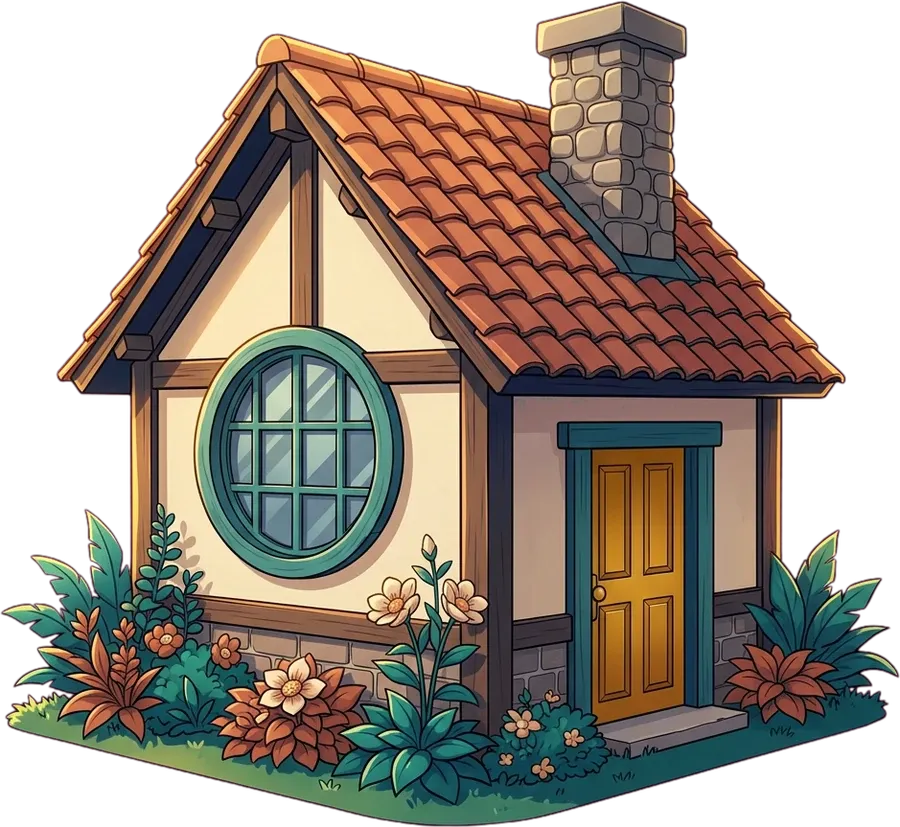
Tess lets herself into the bakery on Mill Street, where five other bakers from the local bakers’ guild are already arguing about which flour makes the best bread. It’s an argument about taste, not supply: there’s plenty of every kind on the shelf. Nobody pays them to come into work. If they’d stayed in bed, the bakery’s machines would have made the town’s bread instead. They came because they love it. To the people who choose to do things, the work is play.
The rule
7:15 a.m.
Lena and Pip
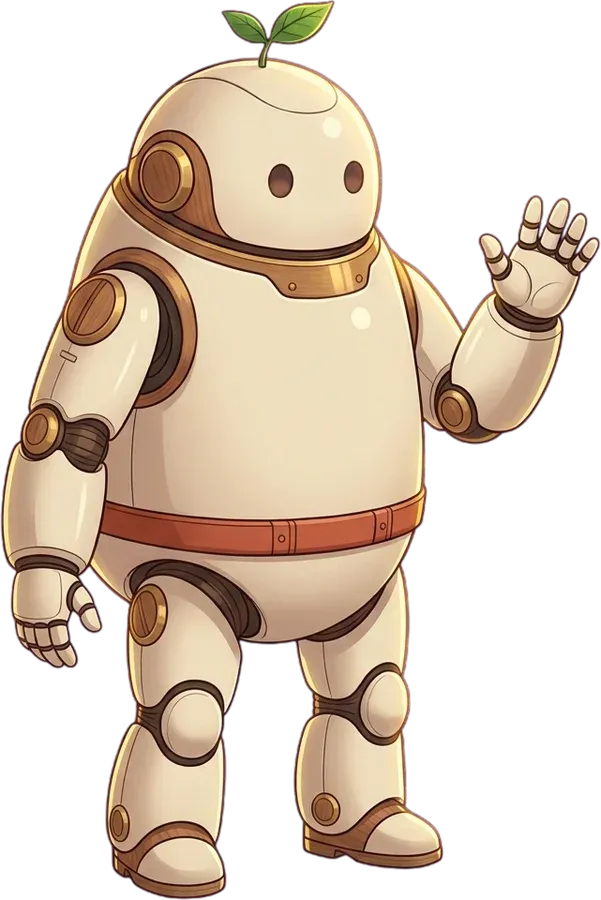
Tess’s daughter Lena, fourteen, eats breakfast with Pip, her personal machine: an AI the family owns, linked to a robot body about as tall as the counter. Pip runs on a small server in the hall closet. It’s the family’s to use however they need, and when they don’t need it, they can lend it out to help with other people’s jobs.
The power
9:30 a.m.
The creek
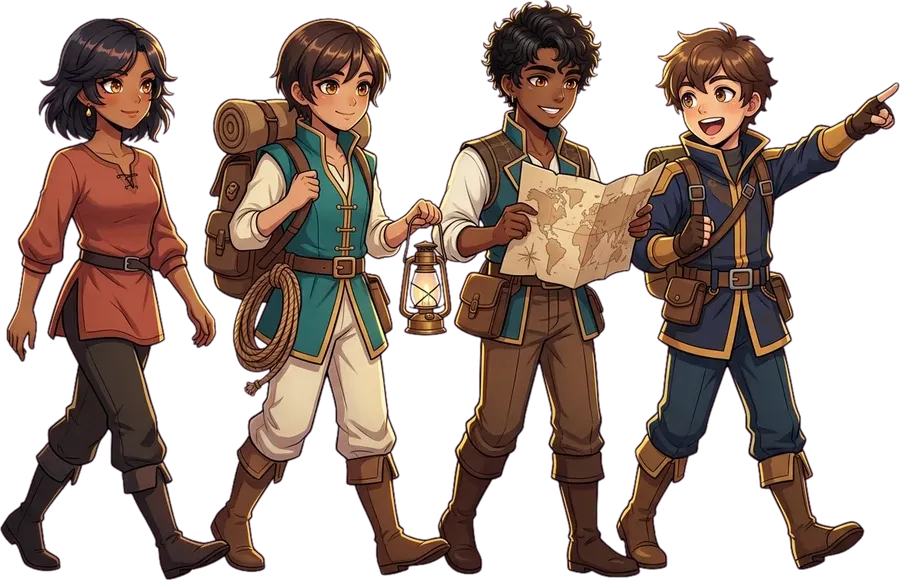
Eleven people in rubber boots are putting the bends back in Willow Creek, which was straightened into a ditch decades ago and now floods the lower fields every spring. They’re also building what would be a startup today: cheap sensors that warn every farm downstream before the water rises. They’re a party, a group formed for one quest that will break up when it’s done, handing the sensors to the town and the design to any town that wants it. The town sent two idle excavators, and the landscaping guild lent a planting robot it wasn’t using.
The frontier
11:00 a.m.
The market
Sam fills a canvas bag with coffee, eggs, apples and the guild’s bread, then walks out. There’s no checkout and no cash exchanged, because every essential need is already paid for. Every household gets a reasonable week of groceries, power, care, what they need to get around and the things they do for fun. We have more important things to spend our effort on than working to pay bills for things we have more than enough of!
The floor
3:00 p.m.
The front hall
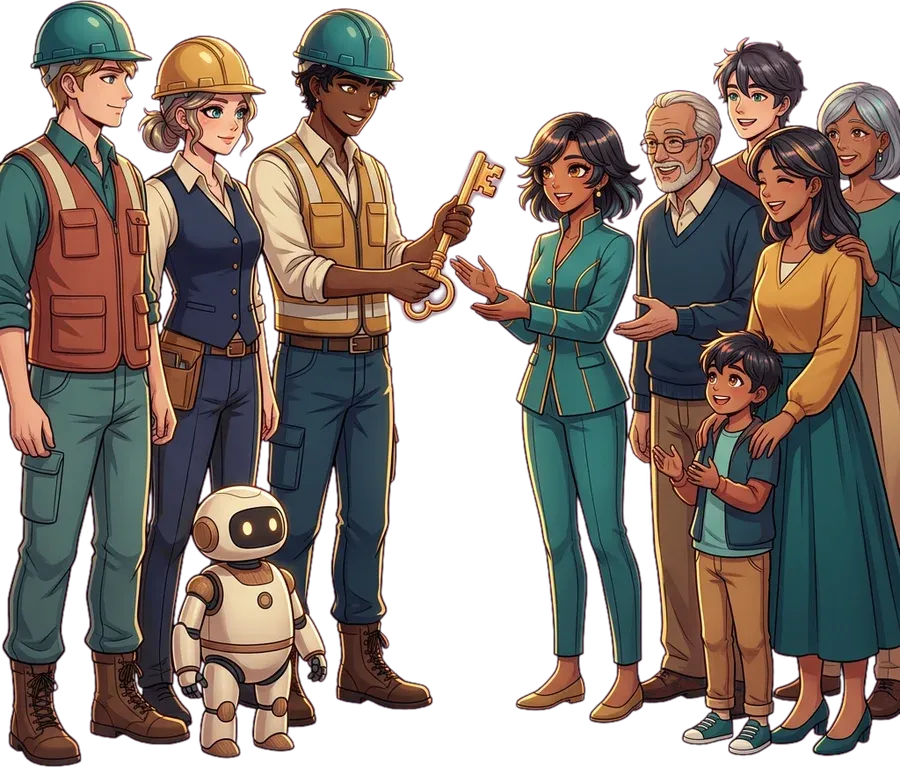
In the town trust’s front hall, a screen shows the town’s books. Every resident owns one equal share of the town’s trust, and with it one vote on how the town’s machines and resources are used: what gets built next and what comes first. Last month Ridgeview sold Dry Creek $48,000 of grain and bought $40,000 of stored solar power. Both towns keep their books on the same shared ledger, so the two trades net out, and only the $8,000 difference was settled in dollars.
The ownership
Ridgeview, its people and every number about them are invented and illustrative.
Rather watch? These four short films cover the same ground in about 12 minutes.
- Part 1 · 3:23 Machines can make us both free and safe
- Part 2 · 2:33 If a human wants to do a job, a machine shouldn’t take it
- Part 5 · 3:57 Every town can own its own power plant and chip fab
- Part 6 · 2:26 UBI won’t work. Universal basic goods will.
About 12 minutes in all.
Eight words you’ll meet first
- Machine labor on demand
- Robots with machine intelligence that anyone can call on for any job, like harvesting a field or fixing a roof. More come when there’s more work, the way the grid sends more power when everyone turns on the AC.
- Personal machine
- Your own AI linked to your own robot. It’s yours to use however you like, nobody else can call on it, and when you don’t need it, you can lend it out.
- Universal basic capital
- The ownership. One equal share per person in the machines that make the essentials. It pays you a cut of what the machines earn and gives you a vote on what gets built next. It can’t be sold, and it moves with you.
- Town trust
- A legal body, run like a utility co-op, that owns a town’s essential machines on behalf of everyone who lives there. Your membership in it is your share.
- Lifeline block
- The free first block every household gets, named after the cheap first block of electricity utilities give homes: a reasonable week of goods and services plus about 20% headroom. Only use past it has a price, so no family ever faces market prices to survive.
- Parties
- A group that forms for one quest, like making a film or building a bridge, shares what it makes, and breaks up when it’s done. Whatever you’d start a startup for today, you’d form a party for tomorrow.
- Guilds
- A group for people who share a craft, like baking, welding or coding. It teaches newcomers, keeps the craft’s standards high, and stays open to anyone who wants to apprentice.
- Second ledger
- A live record of what each town physically has and needs, kept alongside money, not instead of it. It works like the power grid’s market, but for everything, so one town’s spare grain or solar can flow to a town that’s short.
To watch it all work at once, spend an ordinary Tuesday in Ridgeview, a made-up farm town in 2045. To see what it would mean for your own week, your home and your work, try it for yourself.
A Tuesday in Ridgeview What it means for you The full glossary →
About an hour
The core path
Five essays, about 50 minutes in all. Each one opens with a one-minute summary, so you can skim the ones you already agree with.
Start here · 5 min read
The AI industry has never told you what’s in it for youThe public is souring on AI because the industry sells capability and checks, and never says what changes in people’s daily lives.
In one minute
- Half of American adults told Pew in 2025 that AI makes them more concerned than excited, and by June 2026 it was 52%. About half now use chatbots, yet 71% expect AI to mean fewer jobs over the next 20 years.
- The industry pitches capability, an intelligence explosion and a payout like Elon Musk’s universal high income. People hear something else: a risky technology nobody asked for, controlled by a few companies, that will turn their work into managing AI or take it away.
- A better pitch fits in three sentences. If a human wants to do it, a human gets to do it. You get the things, not a check. And your town owns the machines that make your essentials, with an equal share for every resident.
Part 1 · 10 min read · ▶ 3:23 film
Machines can make us both free and safeMachine labor on demand can make the essentials free for everyone, and that safety is exactly what makes real freedom possible.
In one minute
- Freedom and safety aren’t opposites but twins. You can only be free to do what you want if you’re safe from hunger, ruin or losing your home, and machines making food, water, energy, housing, healthcare, transport and communication for everyone can give you that safety.
- Getting there takes three changes: build machine labor on demand, point it at what’s scarce, and swap the corporation for parties, which form for one goal and break up, and guilds, which gather around a craft. An equal share of the machines for everyone, called universal basic capital, spreads the gains.
- Most plans for sharing AI’s gains hand out one thing: a check, free services or a stake in capital. This one, called Universal Basic Everything, gives you machines to call on, the essentials themselves and a share of the machines, all under a rule most AI visions skip. If a human wants to do something, a human gets to do it.
Part 2 · 13 min read · ▶ 2:33 film
If a human wants to do a job, a machine shouldn’t take itMachines should do the work nobody wants, people should get first pick of the rest, and everyone should be able to call on the machines for free.
In one minute
- Machine labor on demand is machine intelligence joined with intelligent bodies, meaning robots, that anyone can call on for any job. Everyone gets a personal machine of their own, anyone can request more for a project or their community, and the essentials always come first.
- Humans are always first in line, and machines fill whatever gap is left. First pick means first pick of the work, not a guaranteed wage. Your living comes from the free essentials and your share of the machines, so the work you choose is for meaning, mastery and care.
- The most detailed plan from the AI world, AI 2040: Plan A, takes care of people with a dividend that climbs toward $1 million per person a year by 2035. But a check only works if there’s enough of the things it buys, and anything still scarce, like land, just rises in price to meet the money.
Part 5 · 11 min read · ▶ 3:57 film
Every town can own its own power plant and chip fabThe machines that make the essentials should belong to every town’s residents in equal, unsellable shares, not to companies or the state.
In one minute
- Under universal basic capital, every resident holds one equal, unsellable share in the machines that make their essentials. Half sits in your town’s trust, a legal body that owns local infrastructure for every resident, and half in a regional fund held by the federation of town trusts.
- Your share moves with you, like porting a phone number, and gives you a vote and a cut of what the machines earn above the floor. The floor itself, a reasonable week of the essentials for free, is your right as a person, not a payout from your share.
- Towns work like microgrids, local power networks that can run on their own, but for everything: each covers its own essentials and sends surplus where neighbors are short. Private builders still pay for the build-out, then hand it to the town’s trust once it’s running.
Part 6 · 11 min read · ▶ 2:26 film
UBI won’t work. Universal basic goods will.A check raises prices without making more of anything, so the floor should be the essentials themselves, made by machines everyone co-owns.
In one minute
- A check only works if there’s enough of what it buys. The 2020 and 2021 relief checks probably added about 3 points to inflation, and once basic needs are met, extra money goes looking for assets instead of building anything new.
- Instead, everyone gets the essentials themselves, free: a reasonable week’s worth of what a typical household uses, plus about 20% headroom, at today’s quality, like a generous free tier. The machines that make it belong to every resident in equal shares nobody can sell, so it can’t be inflated away.
- Money stays for what remains scarce, like beachfront land and original art. Groups formed for a project pool time, machine access and reputation instead of cash, and a second ledger, a running count of each town’s real resources, moves surplus to wherever it’s needed.
Paths by interest
Already have the shape of it? Follow the thread you care about.
Work and meaning
What you’d do all day, and why it would still matter.
- Part 2 If a human wants to do a job, a machine shouldn’t take it 13 min
- Part 4 Quests should replace corporations 16 min
- Part 8 AI will kill packaged meaning. Let it. 18 min
- Part 14 You won’t have a career. You’ll have a skill tree. 16 min
- Part 15 The Olympics, but for everything 15 min
- Part 16 Above self-actualization is the universe 14 min
Economics and policy
How big the free week is, how towns keep count of what they have, how taxes pay for it, and how we get there safely.
- Part 6 UBI won’t work. Universal basic goods will. 11 min
- Part 17 Keep money, add a second ledger 28 min
- Part 18 Every spending bill should show up on your paycheck 19 min
- Part 19 Plan for the bad transition 25 min
- Part 21 The World We Want is mostly constitutional 16 min
- Part 23 Emad Mostaque and I agree on the destination, not the road 16 min
If you work in AI
What the industry promises, who should own the models, and how to stay safe whether AI arrives slowly or all at once.
- Start here The AI industry has never told you what’s in it for you 5 min
- Part 12 Your first party member should be an AI you own 18 min
- Part 20 Get paid to train the robot that takes your job 14 min
- Part 22 Five takes the AI industry needs to ingest 14 min
- Part 24 Doom or foom, the answer is the same: own the machines 13 min
If you’re skeptical
Start with the hardest objections, then the essays that carry the weight.
Futurespective
Help build it
New ideas and films every week or two from Futurespective, by email. Free, with no paywall.