See it · 9 moments

What does your Tuesday look like once machines can do any job?

A Tuesday in Ridgeview

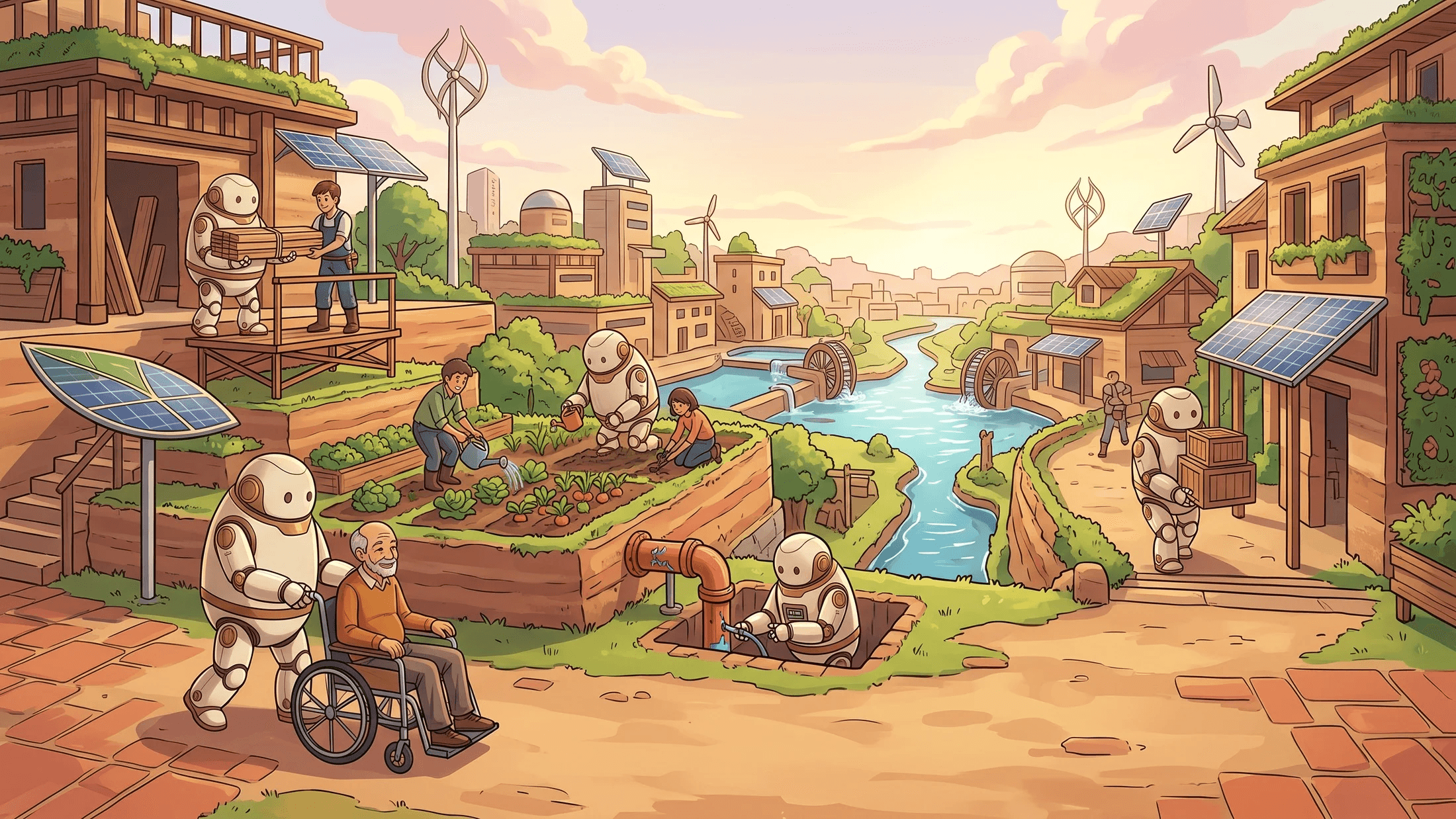
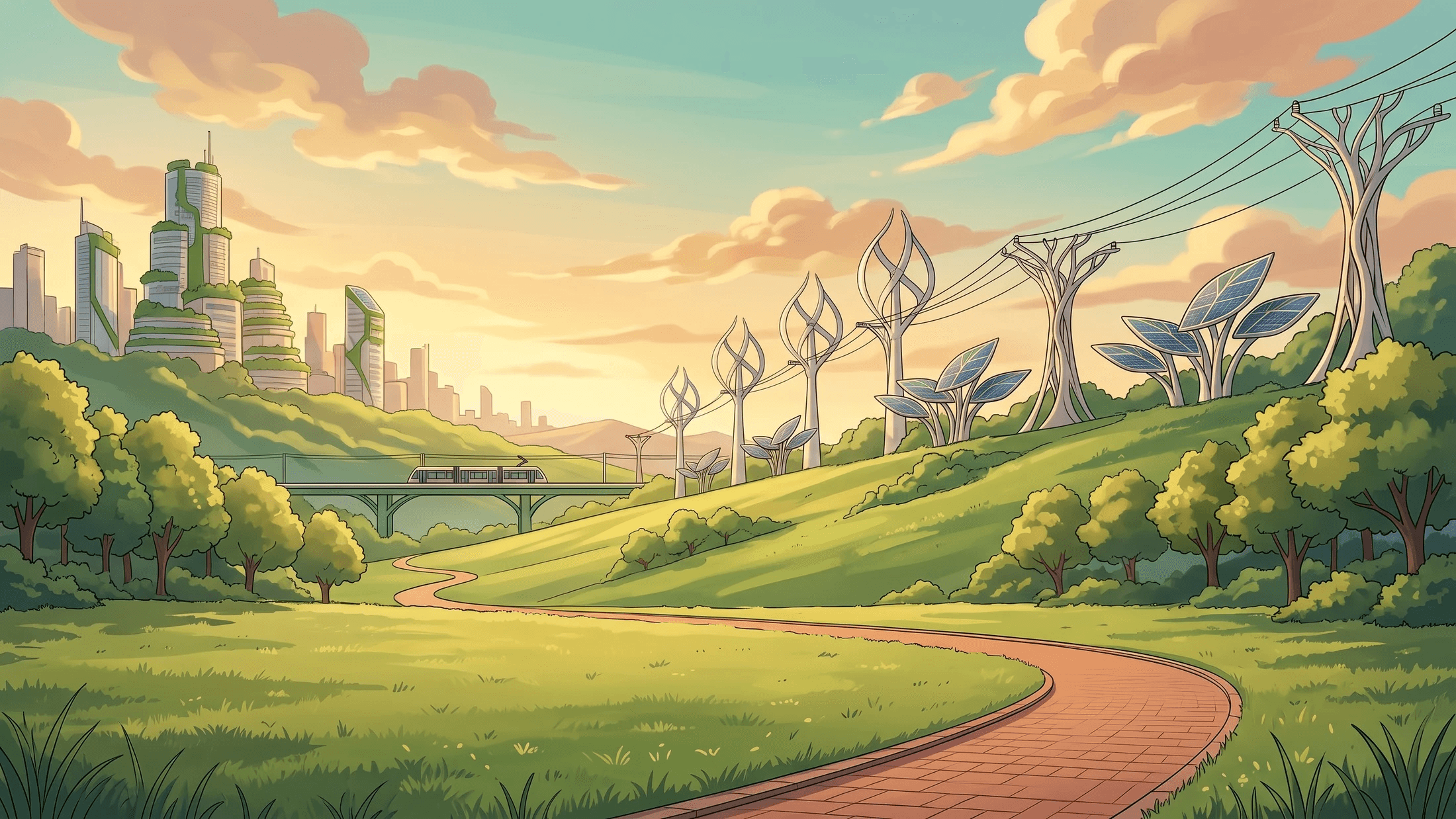
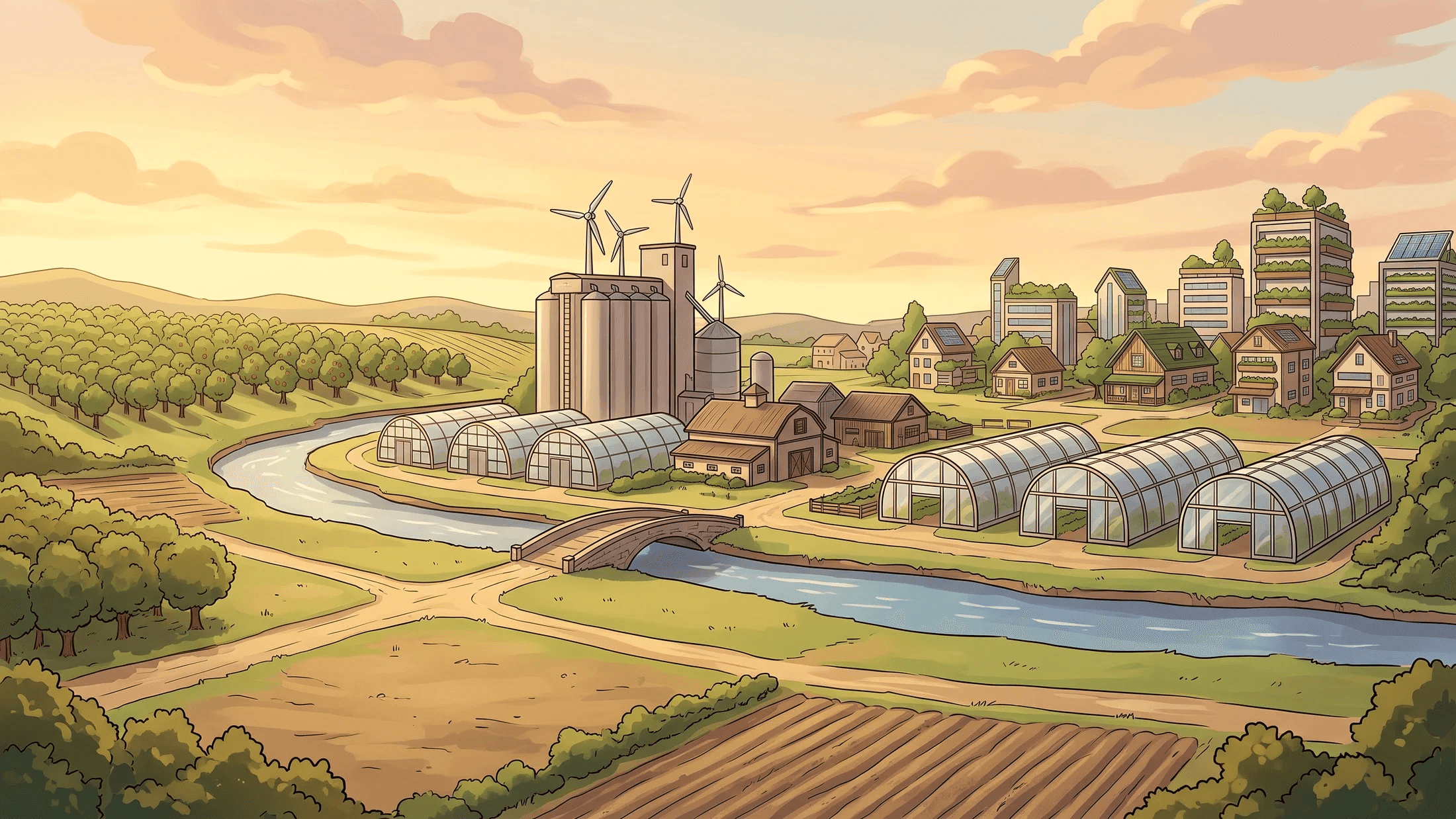
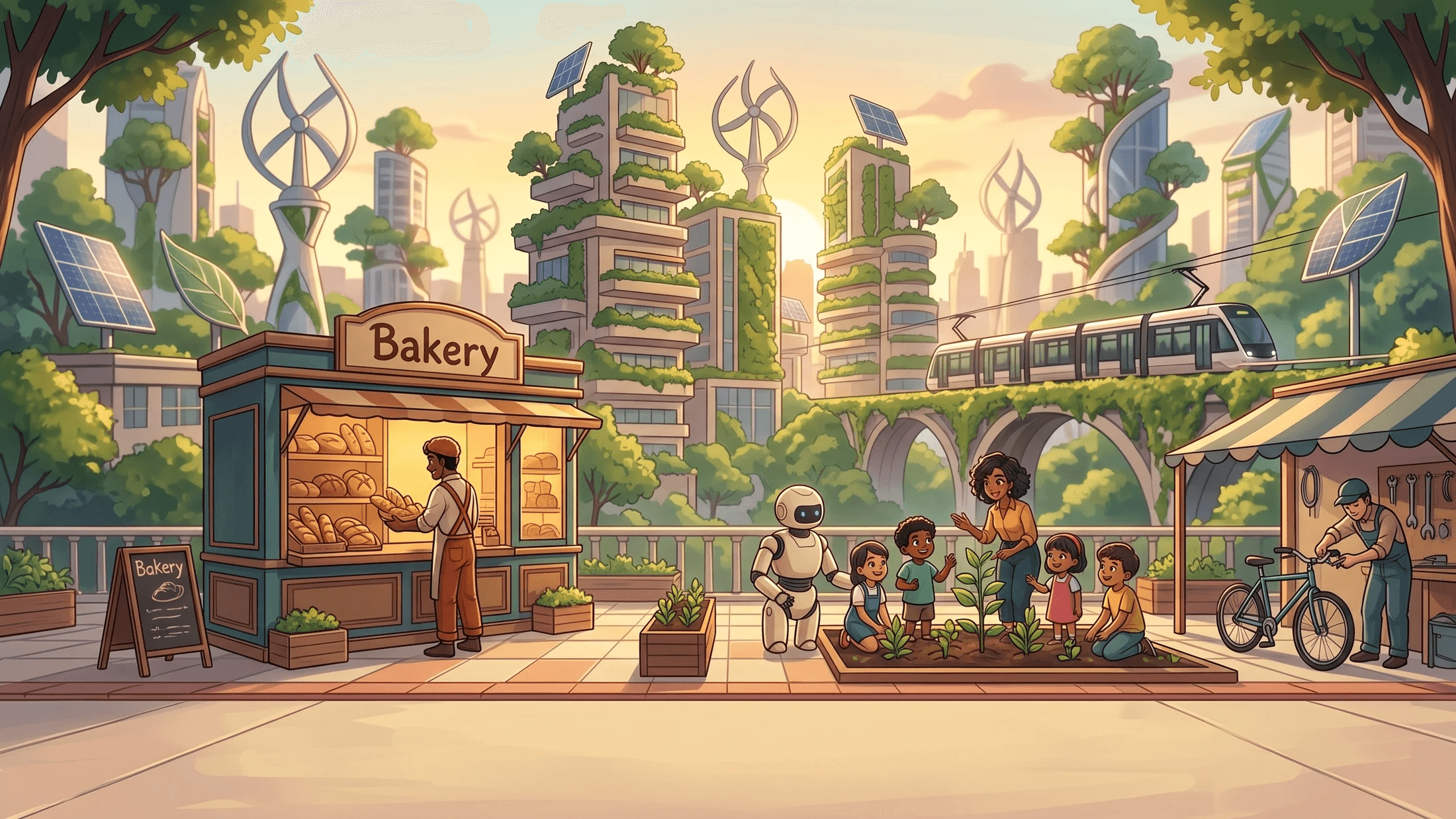
The AI industry has promised us a lot, but nobody has described a weekday. So here’s one: an ordinary Tuesday in 2045, in a farm town that doesn’t exist yet, with Universal Basic Everything quietly running underneath it.

Ridgeview, its neighbor Dry Creek, everyone in them and every number about them are invented. Almost every piece of machinery in the story already exists somewhere.

Before the day starts

Five ideas you’ll see at work

Everything that happens in Ridgeview today rests on five ideas. Here they are in plain words, so you can spot each one when it shows up.

Begin the day

  1. The rule

    People get first pick of the work. If a human wants to do a job, a human gets to do it. Machines fill whatever is left, so the work still gets done when nobody signs up.

  2. The floor

    The essentials are free. The floor is a reasonable week’s worth of the goods and services a typical person or family uses, free, with about 20% headroom on top. Beyond those essentials, we use money to coordinate excess demand.

  3. The power

    Machines are on call for everyone. You own a personal machine, an AI with a robot body that’s yours to use and to lend out when you don’t need it. You also have the same right as everyone else to call on any machine nobody’s using, and the essentials always get served first.

  4. The ownership

    Everyone owns an equal share of the machines. Half of your share sits in your town’s trust, a co-op that owns the local machines, and half in a pool shared across the region, so one disaster can’t wipe it out. It pays you a cut of what the machines earn and gives you one vote on how they’re used. Nobody can sell it, so nobody can buy up the town.

  5. The power

    A home of any size, wherever there’s land. There’s no limit on the size of your home. The only limit is land, and machines can 3D-print a home on any spare lot. So opening spare land for homes is one of the first things a town decides.

An ordinary Tuesday in Ridgeview, in 9 moments

5:40 a.m. The bakery on Mill Street

Tess bakes because she wants to

Tess Okafor lets herself into the bakery while it’s still dark. Five other bakers from the bakers’ guild, the town’s group for people who love the craft, are already there, arguing about whether bread from the new wheat on June Albers’ farm comes out better with a longer rest. It’s an argument about taste, not supply: there’s plenty of every kind of flour on the shelf. They’ll bake it both ways and taste the difference.

Nobody pays Tess to be here, and she doesn’t have a boss. If she’d stayed in bed, the bakery’s machines would have made the town’s bread instead. She came because she loves it. To the people who choose to do things, the work is play.

Last night the guild posted on the town’s work board that six bakers would come in, so two of the bakery’s four bread machines rolled across the road to the cannery, where nobody had signed up to work.

Underneath · The rule

The golden rule. If a human wants to do it, a human gets to do it. Machines fill whatever’s left.

Read Part 2

5:40 a.m. · The rule

BakeryCannerynobody signed up♥ 6 bakers signed up⚙ 2 machines stay⚙ 2 sent herePeople get first pick. Machines fill the rest.

7:15 a.m. Breakfast at the Okafors’

Pip is the family’s, and theirs to lend

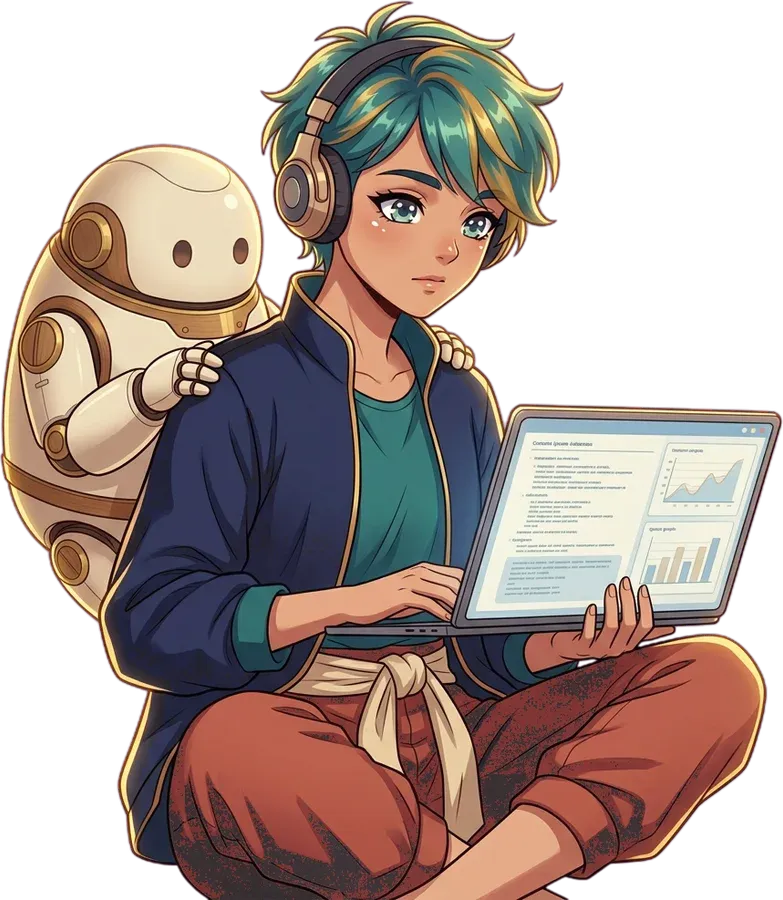
Lena is fourteen, and she’s behind on her algebra. Pip told her so, kindly, over breakfast. Pip is the family’s personal machine: an AI Lena talks to, linked to a robot about the height of a kitchen counter. Every family in Ridgeview has one, the same way they have water.

The family owns Pip, and its mind runs on a small server in the hall closet. It’s theirs to use however they need, and when they don’t need it, they can lend it out to help with other people’s jobs. The town’s dispatch system, which sends idle machines wherever they’re needed, can’t call Pip unless the family says yes. This morning Pip says there’s a 60% chance of rain at the creek, and Lena decides to go anyway. Pip is very good at the odds, but the final call stays with her.

Underneath · The power

Machine labor starts at home. Every household has a machine of its own to use or lend, and everyone has an equal right to call on the town’s idle machines for more.

Read Part 12

7:15 a.m. · The power

The Okafors’ homePipown serverTown dispatchcan’t call Pipcalls idle machines ↓regional computersborrowed when neededOwned by the family. The final call stays human.

8:00 a.m. The trust office on Second Street

Rosa’s board has three lanes

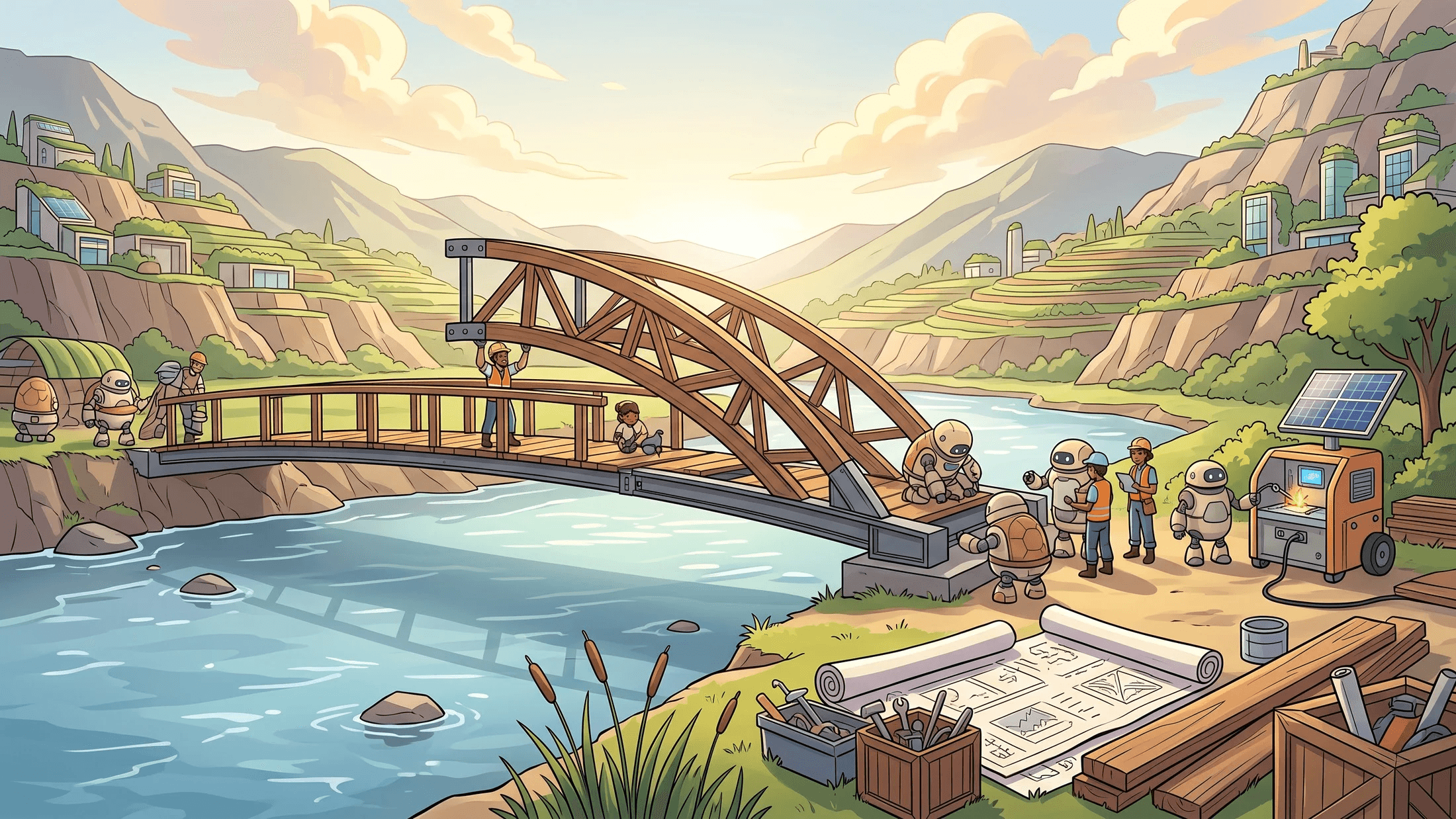
Rosa Delgado runs the dispatch board, a big screen on the wall that sends idle machines wherever they’re needed, the way a dispatcher sends out taxis. Requests line up in three lanes. Water, power, food and care always go first. Projects the town voted for, like a new footbridge, go second. Quests, the projects people take on for their own reasons, go third, and that lane always keeps a guaranteed share of the machines, so no majority can vote anyone’s project out of existence.

This morning all three lanes are green. They usually are, because Ridgeview’s machines were built for the busiest day of the year.

Underneath · The power

Your right to call on idle machines. Requests are filled essentials first, then town projects, then personal quests, and quests always keep a share of the machines for themselves.

Read Part 17

8:00 a.m. · The power

1 Essentials2 Town projects3 Questsalways served firstvoted by residentslocked minimum: no vote can squeeze itBuilt for the busiest day, so most days all three are green.

9:30 a.m. Willow Creek, past the orchards

Eleven people put a creek back

Eleven people in rubber boots are putting the bends back in Willow Creek. Decades ago it was straightened into a ditch, and now it floods the lower fields every spring. They’re a party: a group that forms around one goal with an end, called a quest, and breaks up when it’s done. Tess posted this quest in the spring, and Marcus Bell drove over from Dry Creek to help.

They’re also building what would be a startup today: cheap sensors that warn every farm downstream before the water rises. Here it’s just part of the quest. When the party breaks up, the sensors go to the town, and the design goes to any town that wants it.

Yesterday the party asked for two excavators and a planting robot, and dispatch found idle ones. Calling on a machine costs nothing. But digging wears a machine out, so the town keeps count: everyone gets the same monthly allowance of machine wear, and on a busy week, whoever has used the least so far goes first.

Underneath · The frontier

A party forms around one goal and breaks up when it’s done. Calling on a machine is free, and wear is counted, so on a busy week the heaviest users wait their turn.

Read Part 4

9:30 a.m. · The frontier

Lena2 hTess6 hWalt11 hA neighbor24 h1stmachine wear used this month, same allowance for allCalling a machine is free. Wear is counted, not billed.

11:00 a.m. The Main Street market

Sam doesn’t pay for groceries

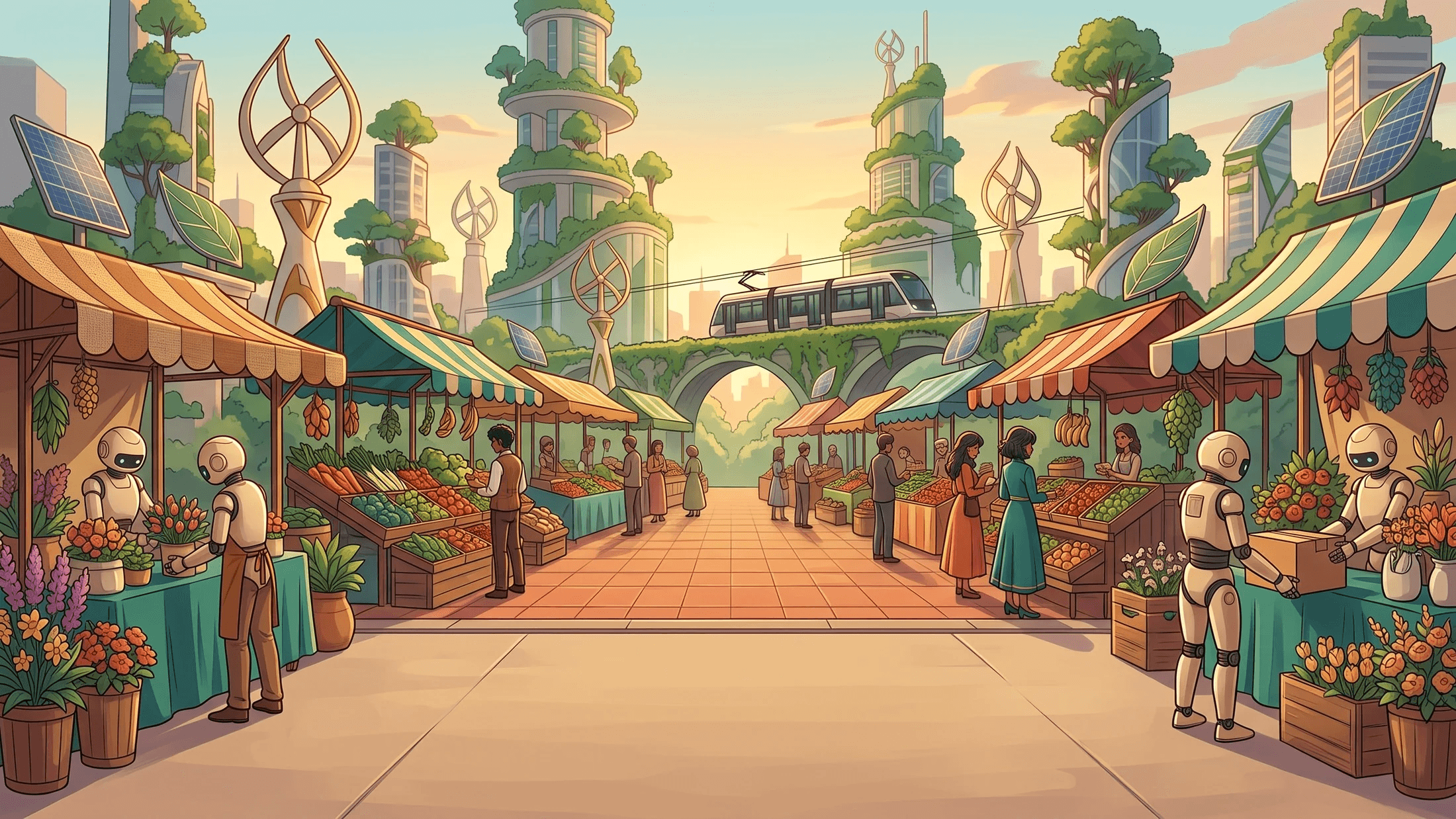
Sam Whitfield fills a canvas bag with coffee, eggs, apples and a loaf of the guild’s bread, and walks out. There’s no checkout and no cash exchanged, because every essential need is already paid for.

Nobody counted Sam’s groceries into a ration. The floor is sized like a normal week: the groceries, power, water, trips, doctor’s visits and everyday fun a household like his uses, plus about 20% headroom, so a heavy week never tips him into paying. Beyond those essentials, the town uses money to coordinate excess demand. Sam is seventy, and he has never come close. Mostly he complains that the bread is too good.

Underneath · The floor

The floor. The things themselves, not a check: a reasonable week of the essentials for every person and family, plus about 20% headroom, free. Only use past that has a price.

Read Part 6

11:00 a.m. · The floor

A household’s weekA reasonable week: free+20%past it: priceda heavy week still lands inside the headroomGroceries · power · water · getting around · carea normal week of each, sized to the householdFree because every essential need is already paid for.No checkout, no form, no proving you’re poor.

3:00 p.m. The trust office’s front hall

The town’s books hang where everyone walks past

A big screen in the front hall shows Ridgeview’s second ledger: a live record, kept beside money, of what the town physically has, makes, uses and loses, in megawatt-hours, cubic meters and tonnes. Like a checkbook for stuff, it has to balance every month.

Last month Ridgeview sent Dry Creek $48,000 of grain and took $40,000 of Dry Creek’s stored solar power for the long autumn evenings. Both towns keep their books on the same shared ledger, so the two trades net out, and only the $8,000 difference was settled in dollars. No family in either town ever saw those prices.

Underneath · The second ledger

Each town’s live count of what it has, and a market between towns that works like the power grid’s. If grain runs short, its price rises between towns and pulls grain in from wherever there’s extra, and no family ever sees that price at the market.

Read Part 17

3:00 p.m. · The second ledger

Ridgeviewfarm valleyDry Creekdesert sun$48,000 of grain$40,000 of solar power$8,000only the differenceOne shared ledger, so the trades net out.

3:05 p.m. The bottom of the same screen

In August, a flag switched itself on

In small type at the bottom of the screen: Conservation flag: off. Last on: August 12 to 14. The conservation flag is the town’s shortage mode. During a heat wave, evening power demand crossed a limit written into the trust’s founding rules, and the flag switched on by itself, the way a grid operator sends an alert on the hottest afternoon of the year.

For three days the machines served the essentials first, cooling for homes and the clinic, and the quests waited. Then supply recovered and the flag lifted on its own. Nobody had to vote, and nobody had to be in charge.

Underneath · The second ledger

The conservation flag. The limits are written down before anyone needs them, so a shortage moves the essentials to the front of the line automatically, and only for as long as it lasts.

Read Part 17

3:05 p.m. · The second ledger

charter limitevening power demandflag onAug 8Aug 12Aug 14Aug 18Essentials first, quests wait, then it lifts itself.

7:00 p.m. The trust’s annual meeting

Sam gets one vote, like everyone

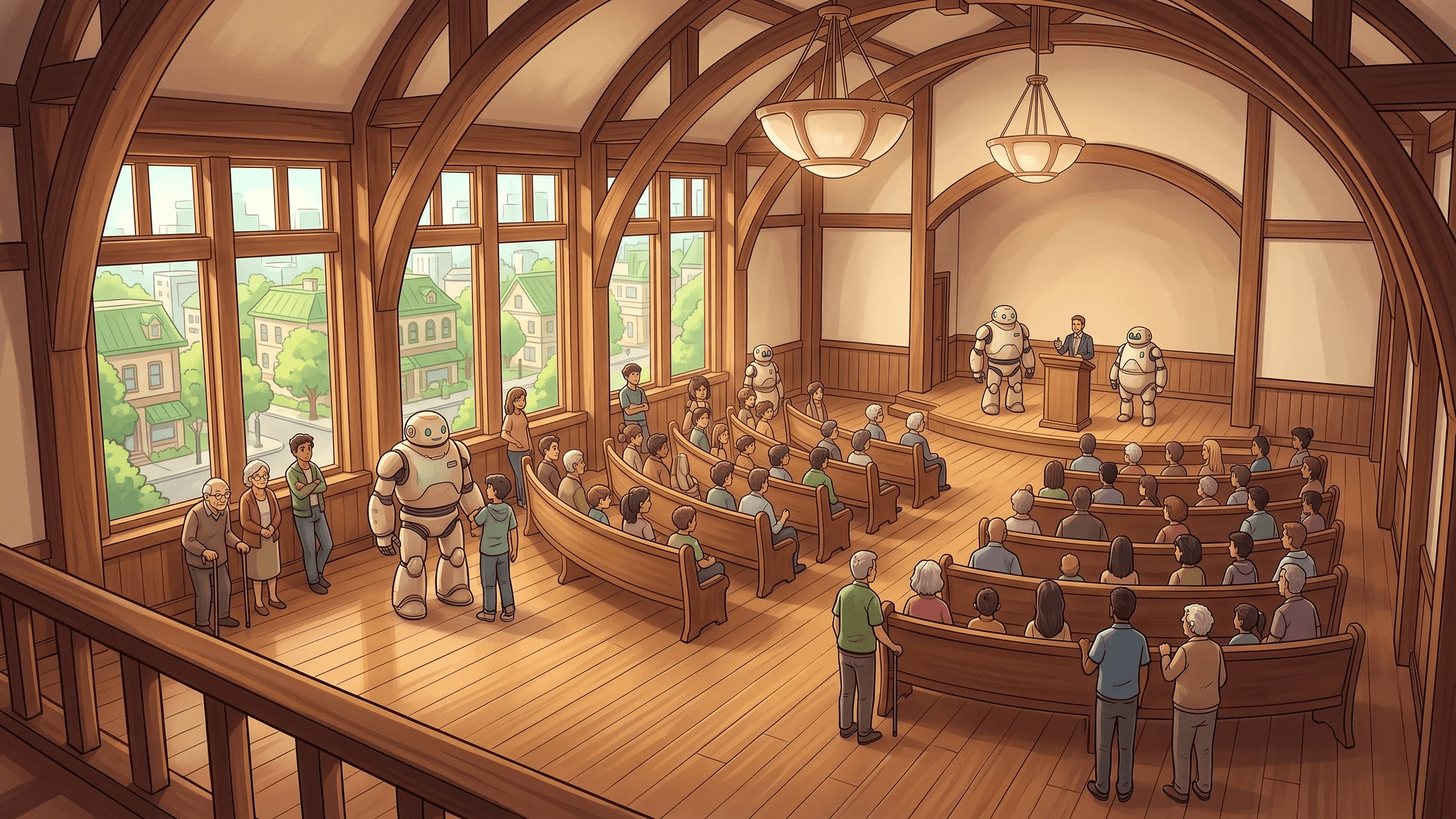
Tonight the town trust meets. It’s the cooperative that owns Ridgeview’s water plant, its microgrid, its shared machines and the land the town holds for homes, and it grew out of the electric co-op that has run the valley’s power lines since the 1930s.

Every resident owns one equal share, and with it one vote on how the town’s machines and land are used: what gets built next and what comes first. Tonight’s question is the old rail yard. Machines can print a home of any size on it, so the only thing to decide is whether to open the land for homes, and how to lay it out.

Half of each share sits in Ridgeview’s trust, which carries the vote. Half sits in the federation of town trusts, so a flood in one valley can’t wipe out its people’s stake. Nobody can sell a share, so nobody can buy the town. Sam voted against the charter in 2027, and he stands up every year to call it “socialism with extra steps.” He still has one vote, and he uses it.

Underneath · The ownership

Universal basic capital: one equal, unsellable share per person in the machines that make the essentials, with one vote on how they’re used. If you move, it moves with you.

Read Part 5

7:00 p.m. · The ownership

½½Ridgeview Town Trustyour vote on its machines and landFederation of trustsspreads the riskNot for saleMoves with youOne share each. Nobody can buy the town.

9:00 p.m. The dark-sky park

Lena finds Andromeda

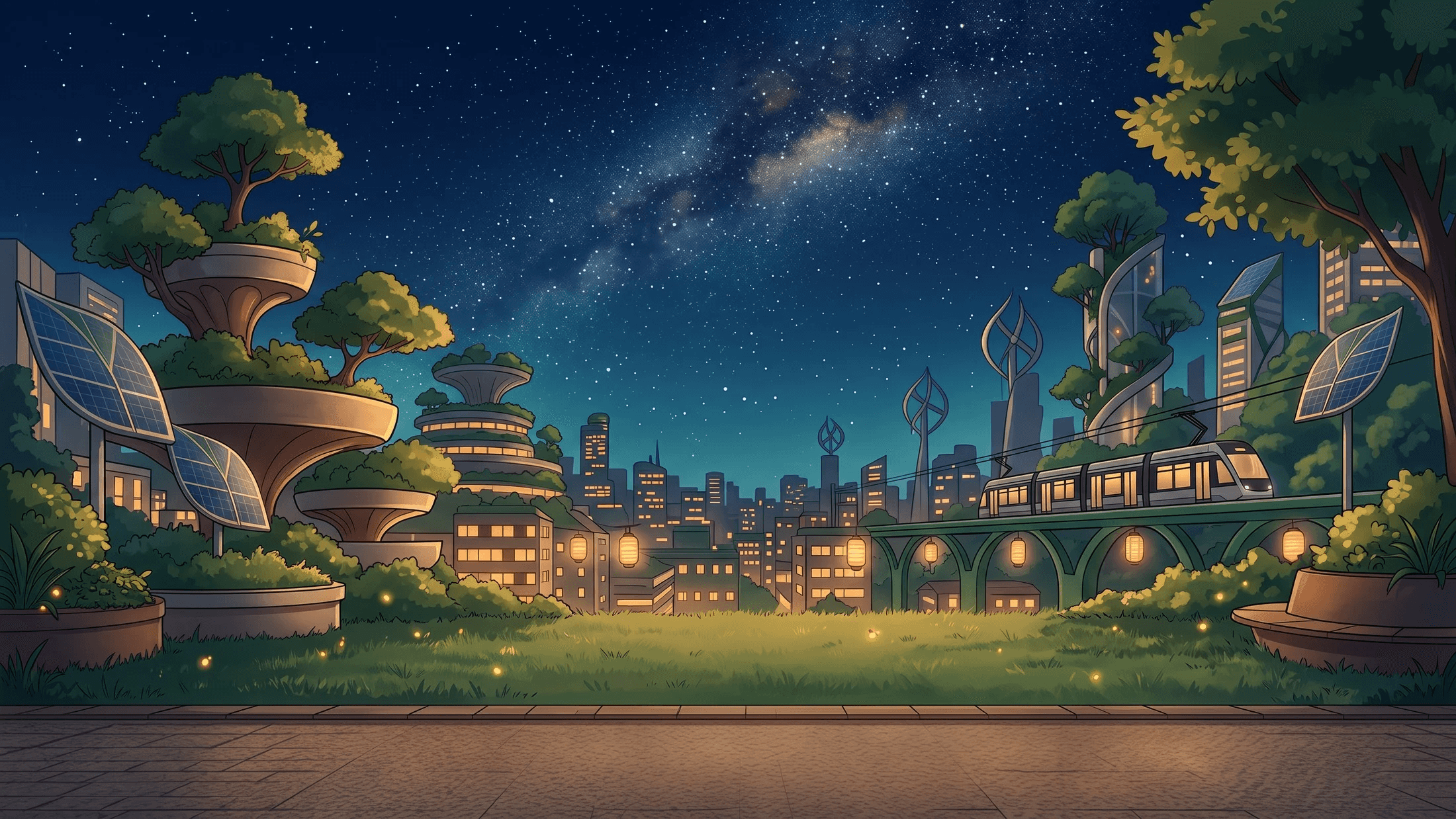
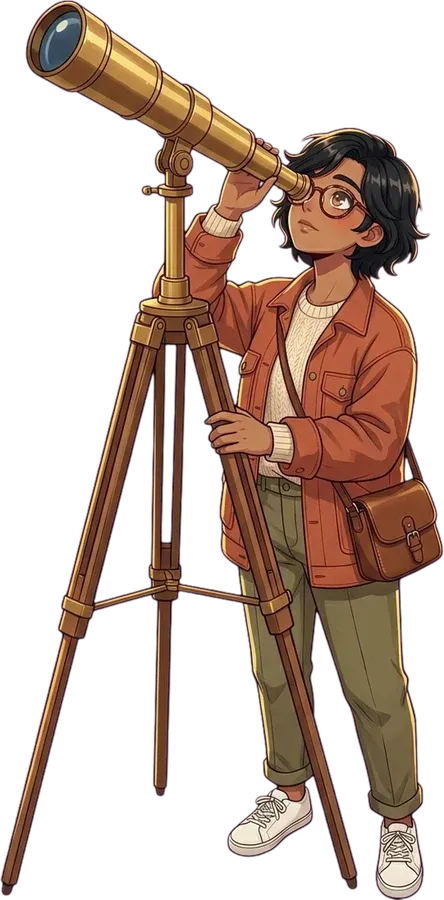
Lena did go to the creek, and it did rain. Now she’s on the hill above town at the telescope the trust owns, with the astronomy club and Ellis, who used to teach physics and comes up most nights to point at things. She asks Pip how far away the Andromeda galaxy is. Then she takes out the earpiece and asks Ellis, because she wants to hear him explain it. He takes twenty minutes. She doesn’t mind.

Everyone in Ridgeview ate today, had power, and could have seen a doctor, whether or not they did any of this.

What it adds up to

Three pieces and one rule

Machines that can do any job are the power. The free essentials they make are the floor. Everyone owning those machines in equal shares is the ownership. And over all three sits the rule: if a human wants to do it, a human gets to. Above the floor is the frontier, everything people choose to do, like Tess’s baking and the creek party. Alongside it all runs the second ledger, the live count that let Ridgeview trade its grain for Dry Creek’s solar power. Together, that’s Universal Basic Everything.

  1. The rule

    If a human wants to do it, a human gets to do it. Machines fill whatever is left.

  2. The frontierWhat you choose to do

    Above the floor, you choose how to organize yourself and spend your time: form parties for completing shared goals, join guilds for learning shared crafts, participate in leagues for the love of the game, and use markets to coordinate only what stays scarce.

    • Parties for goals
    • Guilds for crafts
    • Leagues for the game
    • Markets for the scarce
  3. The floorUniversal basic goods and services

    The floor is a reasonable week’s worth of the goods and services a typical person or family uses, free, with about 20% headroom on top. Beyond those essentials, we use money to coordinate excess demand.

    • Groceries
    • Power and water
    • Getting around
    • Staying connected
    • Seeing a doctor
    • A home
    • Everyday fun
  4. The powerUniversal basic machine labor

    Machine labor on demand: enough intelligent robots to do any job, anywhere, at any time, built to flex up or down with demand. Everyone gets a personal machine of their own, plus an equal right to call on any idle one.

  5. The ownershipUniversal basic capital

    Everyone owns the machines together, in equal shares, so the gains flow to all of us instead of a few. And since anyone can call on the machines nobody’s using, you can pool your time and machine hours with others, like a venture team, and go after the projects you care about, in your town or far beyond it.

Getting there

  1. NowStrengthen the safety net, and write the rest into lawStart with help people need today: unemployment insurance that covers gig and contract workers, a monthly tax credit for low-wage workers, and paid apprenticeships. The next two steps are passed now too, each with a trigger in the data that switches it on, so help never has to wait for a vote in the middle of a crisis.
  2. If wages fallThe cash floor jumps to full sizeIf pay starts falling across the economy, everyone’s monthly cash floor goes straight to its full size: $4,800 a year for each adult and $1,700 for each child. The tax system takes it back as income rises, so most of it reaches the people whose paychecks shrank.
  3. As machines take overBuild each town’s machines, then hand them overIf machines take over so much work that workers’ share of income keeps falling, the public’s cut of AI profits goes into funds that build each town’s own power, water and machines. Once they’re running, they’re handed to the people who live there, one equal share each.
In one sentence Universal Basic Everything: universal basic goods and services, powered by universal basic machine labor, distributed by universal basic capital.

Capital and labor were enemies. Safety and freedom are twins.

When everyone owns an equal share of the machines, ownership becomes the floor under everyone: that’s safety. When machines cover the necessary work, work becomes something you choose: that’s freedom.

That’s the destination

Here’s how we get there

Ridgeview’s Tuesday is what it looks like after the hard part. The road there has five stages, and the dates are estimates, not promises. Each stage opens when a number we can measure, like the price of robots or the share of income going to wages, crosses a line agreed in advance, so good news or bad news can pull the floor forward.

  1. Now to about 2030

    Stage 1: The machine intelligence age

    AI you can call on for any thinking task, everywhere. Meanwhile, build the prototypes: pairs of pilot towns, model laws and contracts, and the safety net’s first switch.

    Opens when Under way

  2. About 2028 to 2035

    Stage 2: Machine labor arrives

    General-purpose robots fill shortages in logistics, construction, care and services.

    Opens when AI revenue or the young-worker job gap crosses a set line

  3. About 2030 to 2040

    Stage 3: The build-out

    Towns build their own small power grids, water plants and factories for what they can’t go without, and trade with their neighbors for the rest.

    Opens when Robots get cheap enough, and pilot pairs pass their two-year tests

  4. About 2035 to 2045

    Stage 4: The gift-back and the floor

    Builders hand finished power plants, water systems and machines over to the towns they serve, and the free floor of essentials becomes real.

    Opens when The share of income going to wages falls a set amount, or towns can cover their own essentials, whichever comes first

  5. 2040 and beyond

    Stage 5: Node states

    Networks of self-reliant towns become the main way people organize their lives. This is Ridgeview’s Tuesday.

    Opens when Most people live in towns that own their machines outright

And a safety net for the dangerous years

Wages can fall faster than towns can build. So three switches are written into law now, while things are calm, and each one flips on by itself when the numbers say so, without waiting for a vote.

  1. Switch A: Now

    Trigger: None: build it in advance

    Unemployment insurance that covers gig workers, a monthly tax credit for low-wage workers, and paid apprenticeships.

  2. Switch B: If wages fall

    Trigger: Long-term unemployment rises and wages fall, or entry-level hiring and pay fall, for two quarters

    Everyone’s monthly cash payment jumps straight to full size: $4,800 a year per adult and $1,700 per child.

  3. Switch C: As machines take over

    Trigger: Workers’ share of national income falls more than 3 points in 3 years

    Speed up building each town’s own machines, and hand them to the people who live there.

Back to the big picture

Now see the whole idea, or try it yourself

Futurespective

The AI industry has had years to tell you what’s in it for you. They failed. Here’s my attempt...

New essays from Futurespective, in your inbox.