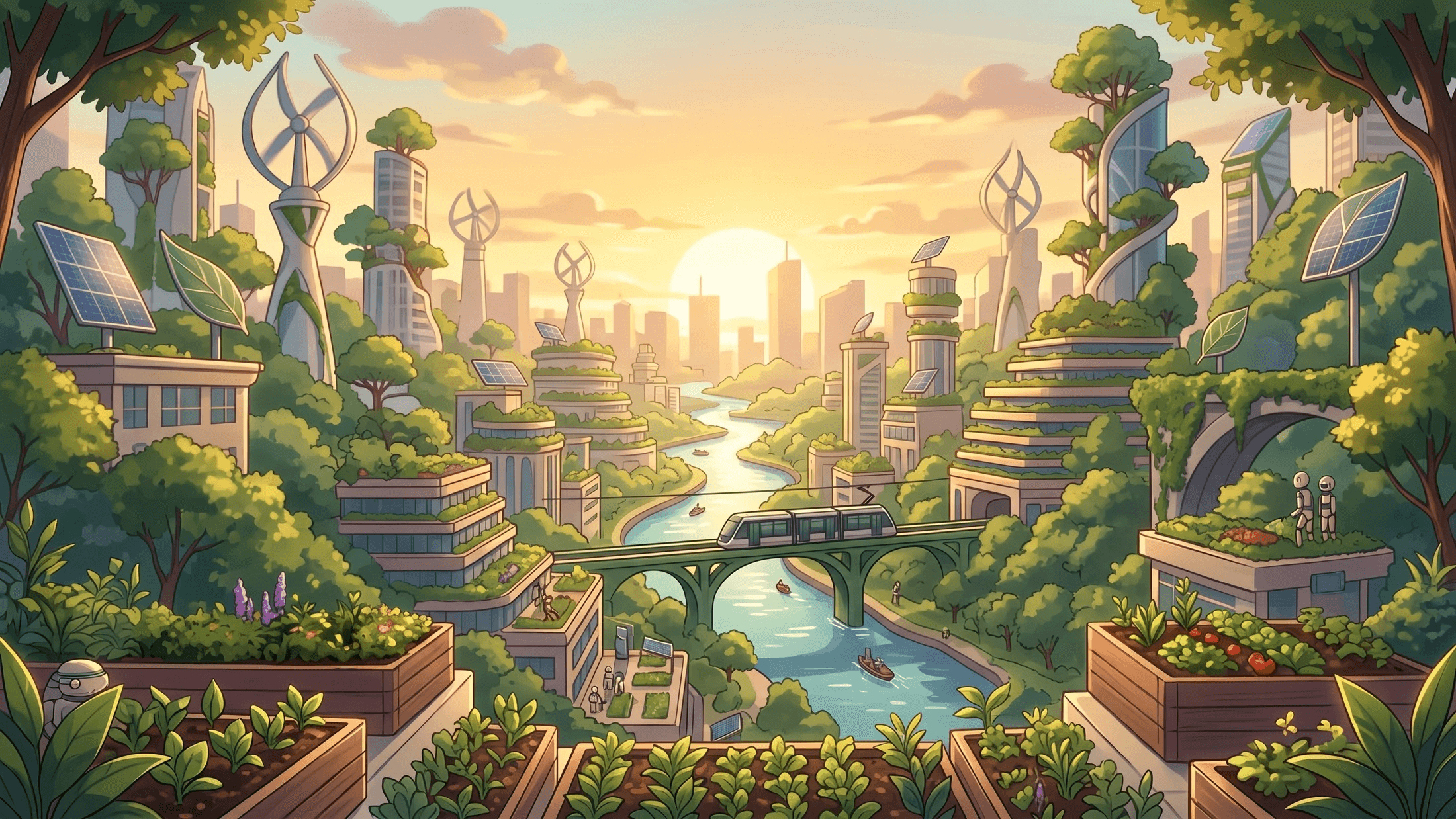
What would this world mean for you?
Machines are learning to do almost any job. Universal Basic Everything is a plan for that world: the essentials free for everyone, an equal share of the machines that make them, and first pick of any work you want to do. Here’s what it would mean for a household like yours.
The short version first
Five ideas, then your walkthrough
Every number you’ll see rests on five ideas. Here they are in plain words first.
The rule
People get first pick of the work. If a human wants to do a job, a human gets to do it. Machines fill whatever is left, so the work still gets done when nobody signs up.
The floor
The essentials are free. The floor is a reasonable week’s worth of the goods and services a typical person or family uses, free, with about 20% headroom on top. Beyond those essentials, we use money to coordinate excess demand.
The power
Machines are on call for everyone. You own a personal machine, an AI with a robot body that’s yours to use and to lend out when you don’t need it. You also have the same right as everyone else to call on any machine nobody’s using, and the essentials always get served first.
The ownership
Everyone owns an equal share of the machines. Half of your share sits in your town’s trust, a co-op that owns the local machines, and half in a pool shared across the region, so one disaster can’t wipe it out. It pays you a cut of what the machines earn and gives you one vote on how they’re used. Nobody can sell it, so nobody can buy up the town.
The power
A home of any size, wherever there’s land. There’s no limit on the size of your home. The only limit is land, and machines can 3D-print a home on any spare lot. So opening spare land for homes is one of the first things a town decides.

Showing the walkthrough for a household of one
Your world, in six parts
Here’s what this world would mean for one person living alone. Pick who you are above, and every part changes to fit.
Your week
The floor
For a household of one Whatever happens to your job or your luck, a reasonable week of the essentials is there every week.
Picture all the things we need to pay for to get by in a normal week, today: the groceries we buy for our families, the power and water we use, getting where we need to go, staying connected, seeing a doctor when we need to, and the things we do for fun, too.
AdultsChildrenYour household’s week Illustrative
Part of the week A reasonable week Free, with headroom GroceriesWhat a typical household brings home in a week 2 bags 2.4 bags PowerHeating, cooling, cooking, charging 60 kWh 72 kWh WaterDrinking, washing, a garden 4 hundred gallons 5 hundred gallons Getting aroundWork, school, errands, visits 12 trips 14 trips Seeing a doctorCheckups, a sick day, a prescription 0.2 visits 0.2 visits A homeIts size is up to you and your land No size limit. See “Your home” below. A reasonable week: free Headroom: free Past the cap: priced
An ordinary week. All of it is free, and nobody asks you anything.
The “floor” we’re proposing covers a reasonable amount of all of that for every person and family, plus about 20% more, so a heavy week never tips you over into paying out of pocket. Past that cap, extra goods and services have a price, and nobody has to fill out a form or prove they’re poor to get the essentials they need to live.
It’s free because every essential need is already paid for.
Illustrative. The basket is invented to show the shape of the idea, not a forecast or a standard. A real town would size its reasonable week from what households there use now, and review it every year.
Read more Part 6: UBI won’t work. Universal basic goods will. · Whitepaper: lifeline blocks in practice
Your home
Housing and land
For a household of one Your home can be as big as your land and your plans allow. The question is where there’s room, not what you can afford.
Housing is the hard part. There’s no limit on the size of your home: wherever there’s spare land, machines can 3D-print a house as big as you want, or add a room to the one you have. So how big your home gets depends on the land you have and how you want to use it.
The catch is the land itself. Almost everyone would take more room if they could, and the land inside a city doesn’t grow. That’s why housing in every city is one of the first jobs for the machines: homes printed fast on the spare land a town already has, like an empty lot or an old rail yard, so a home is never the thing you can’t afford.
Land is the hard part Illustrative
Machines can print a home on every one of them, at whatever size the people moving in want. The limit is the 4 plots, not the machines.
An illustration, not a forecast. The town and its plots are invented.
Read more Part 3: Point the machines at what’s scarce · Part 5: Every town can own its own power plant and chip fab
Your machine time
Universal basic machine labor
For a household of one Your personal machine answers to you, and whenever you have something to build, you can call on any machine nobody else is using.
You own a personal machine. Today it’s an AI of your own, and as robots get good and cheap enough, it gets a body too. It’s yours to use, and you can lend it out when you don’t need it. Beyond your own machine, you can call on any machine nobody’s using.
When you call on more, dispatch fills requests in this order
- Tier 1 Essentials and urgent shortages, like water, power, food and care
- Tier 2 Projects your town votes on
- Tier 3 Everyone’s own projects, which always keep a guaranteed share of the machines
The wear allowance
You never pay for machine time. But every job wears a machine down a little, so each person gets the same allowance of wear each month. When machines are plentiful, everyone gets what they ask for. When they’re tight, whoever has used the least goes first.
Machines this week- Walt
- Tess
- Rosa
- Sam
- June
- You
Plenty of machines: every request is filled, in the order received.
Cost to you: $0, either way
Your personal machine is the one exception to sharing: nobody can call it unless you lend it. A party’s use is split among its members, so joining more parties doesn’t multiply anyone’s allowance.
Read more Part 2: If a human wants to do a job, a machine shouldn’t take it · Part 17: Keep money, add a second ledger · Whitepaper: Universal basic machine labor: equal access, distributed by demand
Your work
Guilds, quests and the rule
For a household of one You choose what to work on. The floor carries you either way.
If a human wants to do it, a human gets to do it. Machines fill whatever’s left.
Parties
A party forms around one goal, called a quest, like restoring a creek or building a clinic, and breaks up when it’s done. What you’d start a startup for today becomes a party tomorrow. You pick who you want to work with, and machines fill the roles nobody picks.
Guilds
A guild is a group for a shared craft, like baking or beekeeping. It teaches newcomers, keeps the standards high and runs friendly competitions, and it has to stay open to anyone who wants to apprentice.
Try it: who bakes tomorrow
6 bakers want to bake, so dispatch parks 2 of the four machines and sends their hours to the cannery, where nobody signed up. The town gets its bread either way.
It’s a right to do the work, not a right to be paid for it, because the floor already carries everyone. And it never puts the essential systems at risk: machines always keep the water and power running.
Read more Part 4: Quests should replace corporations · Part 14: You won’t have a career. You’ll have a skill tree. · Whitepaper: The golden rule, in full
What it costs
The cash floor and one formula
For a household of one Until the free essentials are built, a monthly check to everyone carries you there, and it shrinks as more of your week becomes free.
Building the free floor takes years, so until it’s ready, everyone gets a monthly check: $4,800 a year per adult and $1,700 per child at full size. One tax rate on income pays for it and takes it back as your income rises.
Rate = spending ÷ tax base + a debt surcharge
Set by law every year, so every spending bill shows up on next year’s paycheck. There’s no point where earning one more dollar makes you lose the whole check. The same rate simply takes it back, a little at a time, as your income rises.
- Your household’s check
- $4,800 a year$400 a month
- 30% of your income
- $12,000 a yearon $40,000 of income
- Net
- You pay $7,200 more than the check, as tax.
30% is an example: at that rate, an adult’s check and their tax cancel out at $16,000 of earnings. The real rate comes out of the formula each year, about 34 to 35% at full size while the national debt is above 60% of GDP, with wages taxed about 2.4 points less and income from owning things about 5.6 points more. As each essential becomes free, the check shrinks.
Read more Part 18: Every spending bill should show up on your paycheck · Part 19: Plan for the bad transition · Whitepaper: The cash path: one schedule
Showing the walkthrough for someone who works for a living
Your world, in six parts
You work for a living, and you keep hearing that machines are coming for jobs like yours. Here’s what would change for you, and what wouldn’t.
Your week
The floor
For someone who works for a living Your home, power, food and doctor stop depending on your paycheck. If your job changes or disappears, your floor doesn’t.
Picture all the things we need to pay for to get by in a normal week, today: the groceries we buy for our families, the power and water we use, getting where we need to go, staying connected, seeing a doctor when we need to, and the things we do for fun, too.
AdultsChildrenYour household’s week Illustrative
Part of the week A reasonable week Free, with headroom GroceriesWhat a typical household brings home in a week 2 bags 2.4 bags PowerHeating, cooling, cooking, charging 60 kWh 72 kWh WaterDrinking, washing, a garden 4 hundred gallons 5 hundred gallons Getting aroundWork, school, errands, visits 12 trips 14 trips Seeing a doctorCheckups, a sick day, a prescription 0.2 visits 0.2 visits A homeIts size is up to you and your land No size limit. See “Your home” below. A reasonable week: free Headroom: free Past the cap: priced
An ordinary week. All of it is free, and nobody asks you anything.
The “floor” we’re proposing covers a reasonable amount of all of that for every person and family, plus about 20% more, so a heavy week never tips you over into paying out of pocket. Past that cap, extra goods and services have a price, and nobody has to fill out a form or prove they’re poor to get the essentials they need to live.
It’s free because every essential need is already paid for.
Illustrative. The basket is invented to show the shape of the idea, not a forecast or a standard. A real town would size its reasonable week from what households there use now, and review it every year.
Read more Part 6: UBI won’t work. Universal basic goods will. · Whitepaper: lifeline blocks in practice
Your home
Housing and land
For someone who works for a living Rent stops eating your paycheck. Your town prints homes on its spare land, so a home isn’t the thing you can’t afford.
Housing is the hard part. There’s no limit on the size of your home: wherever there’s spare land, machines can 3D-print a house as big as you want, or add a room to the one you have. So how big your home gets depends on the land you have and how you want to use it.
The catch is the land itself. Almost everyone would take more room if they could, and the land inside a city doesn’t grow. That’s why housing in every city is one of the first jobs for the machines: homes printed fast on the spare land a town already has, like an empty lot or an old rail yard, so a home is never the thing you can’t afford.
Land is the hard part Illustrative
Machines can print a home on every one of them, at whatever size the people moving in want. The limit is the 4 plots, not the machines.
An illustration, not a forecast. The town and its plots are invented.
Read more Part 3: Point the machines at what’s scarce · Part 5: Every town can own its own power plant and chip fab
Your machine time
Universal basic machine labor
For someone who works for a living Your personal machine works for you, not your employer. And you can call on more for anything you want to build.
You own a personal machine. Today it’s an AI of your own, and as robots get good and cheap enough, it gets a body too. It’s yours to use, and you can lend it out when you don’t need it. Beyond your own machine, you can call on any machine nobody’s using.
When you call on more, dispatch fills requests in this order
- Tier 1 Essentials and urgent shortages, like water, power, food and care
- Tier 2 Projects your town votes on
- Tier 3 Everyone’s own projects, which always keep a guaranteed share of the machines
The wear allowance
You never pay for machine time. But every job wears a machine down a little, so each person gets the same allowance of wear each month. When machines are plentiful, everyone gets what they ask for. When they’re tight, whoever has used the least goes first.
Machines this week- Walt
- Tess
- Rosa
- Sam
- June
- You
Plenty of machines: every request is filled, in the order received.
Cost to you: $0, either way
Your personal machine is the one exception to sharing: nobody can call it unless you lend it. A party’s use is split among its members, so joining more parties doesn’t multiply anyone’s allowance.
Read more Part 2: If a human wants to do a job, a machine shouldn’t take it · Part 17: Keep money, add a second ledger · Whitepaper: Universal basic machine labor: equal access, distributed by demand
Your work
Guilds, quests and the rule
For someone who works for a living If you love your job, it stays yours, because a human who wants the work gets it first. If you don’t, you can walk away without losing your home.
If a human wants to do it, a human gets to do it. Machines fill whatever’s left.
Parties
A party forms around one goal, called a quest, like restoring a creek or building a clinic, and breaks up when it’s done. What you’d start a startup for today becomes a party tomorrow. You pick who you want to work with, and machines fill the roles nobody picks.
Guilds
A guild is a group for a shared craft, like baking or beekeeping. It teaches newcomers, keeps the standards high and runs friendly competitions, and it has to stay open to anyone who wants to apprentice.
Try it: who bakes tomorrow
6 bakers want to bake, so dispatch parks 2 of the four machines and sends their hours to the cannery, where nobody signed up. The town gets its bread either way.
It’s a right to do the work, not a right to be paid for it, because the floor already carries everyone. And it never puts the essential systems at risk: machines always keep the water and power running.
Read more Part 4: Quests should replace corporations · Part 14: You won’t have a career. You’ll have a skill tree. · Whitepaper: The golden rule, in full
What it costs
The cash floor and one formula
For someone who works for a living If wages start falling before the free essentials are built, everyone’s monthly cash payment jumps to full size automatically, as soon as the numbers show it, without waiting for Congress.
Building the free floor takes years, so until it’s ready, everyone gets a monthly check: $4,800 a year per adult and $1,700 per child at full size. One tax rate on income pays for it and takes it back as your income rises.
Rate = spending ÷ tax base + a debt surcharge
Set by law every year, so every spending bill shows up on next year’s paycheck. There’s no point where earning one more dollar makes you lose the whole check. The same rate simply takes it back, a little at a time, as your income rises.
- Your household’s check
- $4,800 a year$400 a month
- 30% of your income
- $14,400 a yearon $48,000 of income
- Net
- You pay $9,600 more than the check, as tax.
30% is an example: at that rate, an adult’s check and their tax cancel out at $16,000 of earnings. The real rate comes out of the formula each year, about 34 to 35% at full size while the national debt is above 60% of GDP, with wages taxed about 2.4 points less and income from owning things about 5.6 points more. As each essential becomes free, the check shrinks.
Read more Part 18: Every spending bill should show up on your paycheck · Part 19: Plan for the bad transition · Whitepaper: The cash path: one schedule
Showing the walkthrough for a parent
Your world, in six parts
You’re raising kids, and you want to know what kind of world they’ll grow up in. Here’s what your household would get.
Your week
The floor
For a parent The floor is sized to your family’s real week, so a bigger family gets a bigger week and doesn’t reach the priced part any sooner. Schooling is part of the floor too.
Picture all the things we need to pay for to get by in a normal week, today: the groceries we buy for our families, the power and water we use, getting where we need to go, staying connected, seeing a doctor when we need to, and the things we do for fun, too.
AdultsChildrenYour household’s week Illustrative
Part of the week A reasonable week Free, with headroom GroceriesWhat a typical household brings home in a week 6 bags 7 bags PowerHeating, cooling, cooking, charging 170 kWh 204 kWh WaterDrinking, washing, a garden 12 hundred gallons 14 hundred gallons Getting aroundWork, school, errands, visits 40 trips 48 trips Seeing a doctorCheckups, a sick day, a prescription 1 visits 1.2 visits A homeIts size is up to you and your land No size limit. See “Your home” below. A reasonable week: free Headroom: free Past the cap: priced
An ordinary week. All of it is free, and nobody asks you anything.
The “floor” we’re proposing covers a reasonable amount of all of that for every person and family, plus about 20% more, so a heavy week never tips you over into paying out of pocket. Past that cap, extra goods and services have a price, and nobody has to fill out a form or prove they’re poor to get the essentials they need to live.
It’s free because every essential need is already paid for.
Illustrative. The basket is invented to show the shape of the idea, not a forecast or a standard. A real town would size its reasonable week from what households there use now, and review it every year.
Read more Part 6: UBI won’t work. Universal basic goods will. · Whitepaper: lifeline blocks in practice
Your home
Housing and land
For a parent When the family grows, the house can grow with it. Machines can print a new room on the land you already have.
Housing is the hard part. There’s no limit on the size of your home: wherever there’s spare land, machines can 3D-print a house as big as you want, or add a room to the one you have. So how big your home gets depends on the land you have and how you want to use it.
The catch is the land itself. Almost everyone would take more room if they could, and the land inside a city doesn’t grow. That’s why housing in every city is one of the first jobs for the machines: homes printed fast on the spare land a town already has, like an empty lot or an old rail yard, so a home is never the thing you can’t afford.
Land is the hard part Illustrative
Machines can print a home on every one of them, at whatever size the people moving in want. The limit is the 4 plots, not the machines.
An illustration, not a forecast. The town and its plots are invented.
Read more Part 3: Point the machines at what’s scarce · Part 5: Every town can own its own power plant and chip fab
Your machine time
Universal basic machine labor
For a parent Each child gets a personal machine of their own: a tutor and companion that answers to them, which nobody else can call.
You own a personal machine. Today it’s an AI of your own, and as robots get good and cheap enough, it gets a body too. It’s yours to use, and you can lend it out when you don’t need it. Beyond your own machine, you can call on any machine nobody’s using.
When you call on more, dispatch fills requests in this order
- Tier 1 Essentials and urgent shortages, like water, power, food and care
- Tier 2 Projects your town votes on
- Tier 3 Everyone’s own projects, which always keep a guaranteed share of the machines
The wear allowance
You never pay for machine time. But every job wears a machine down a little, so each person gets the same allowance of wear each month. When machines are plentiful, everyone gets what they ask for. When they’re tight, whoever has used the least goes first.
Machines this week- Walt
- Tess
- Rosa
- Sam
- June
- You
Plenty of machines: every request is filled, in the order received.
Cost to you: $0, either way
Your personal machine is the one exception to sharing: nobody can call it unless you lend it. A party’s use is split among its members, so joining more parties doesn’t multiply anyone’s allowance.
Read more Part 2: If a human wants to do a job, a machine shouldn’t take it · Part 17: Keep money, add a second ledger · Whitepaper: Universal basic machine labor: equal access, distributed by demand
Your work
Guilds, quests and the rule
For a parent Care counts. Caregivers can join a guild, a group for people who share a craft, that trains them and gives care work the recognition it has rarely had. And nobody has to pick between a paycheck and time with their kids.
If a human wants to do it, a human gets to do it. Machines fill whatever’s left.
Parties
A party forms around one goal, called a quest, like restoring a creek or building a clinic, and breaks up when it’s done. What you’d start a startup for today becomes a party tomorrow. You pick who you want to work with, and machines fill the roles nobody picks.
Guilds
A guild is a group for a shared craft, like baking or beekeeping. It teaches newcomers, keeps the standards high and runs friendly competitions, and it has to stay open to anyone who wants to apprentice.
Try it: who bakes tomorrow
6 bakers want to bake, so dispatch parks 2 of the four machines and sends their hours to the cannery, where nobody signed up. The town gets its bread either way.
It’s a right to do the work, not a right to be paid for it, because the floor already carries everyone. And it never puts the essential systems at risk: machines always keep the water and power running.
Read more Part 4: Quests should replace corporations · Part 14: You won’t have a career. You’ll have a skill tree. · Whitepaper: The golden rule, in full
What it costs
The cash floor and one formula
For a parent At full size, the cash floor pays $1,700 a year for each child, and no part of it ends at a cliff.
Building the free floor takes years, so until it’s ready, everyone gets a monthly check: $4,800 a year per adult and $1,700 per child at full size. One tax rate on income pays for it and takes it back as your income rises.
Rate = spending ÷ tax base + a debt surcharge
Set by law every year, so every spending bill shows up on next year’s paycheck. There’s no point where earning one more dollar makes you lose the whole check. The same rate simply takes it back, a little at a time, as your income rises.
- Your household’s check
- $13,000 a year$1,083 a month
- 30% of your income
- $25,500 a yearon $85,000 of income
- Net
- You pay $12,500 more than the check, as tax.
30% is an example: at that rate, an adult’s check and their tax cancel out at $16,000 of earnings. The real rate comes out of the formula each year, about 34 to 35% at full size while the national debt is above 60% of GDP, with wages taxed about 2.4 points less and income from owning things about 5.6 points more. As each essential becomes free, the check shrinks.
Read more Part 18: Every spending bill should show up on your paycheck · Part 19: Plan for the bad transition · Whitepaper: The cash path: one schedule
Showing the walkthrough for someone who’s retired
Your world, in six parts
You’ve finished your working life, or you’re close. Here’s what this world would give you, and what you could still do if you felt like it.
Your week
The floor
For someone who’s retired Healthcare sits in the floor in full: primary care, mental health, dental, medicines and emergency care. A documented medical need makes your reasonable week bigger.
Picture all the things we need to pay for to get by in a normal week, today: the groceries we buy for our families, the power and water we use, getting where we need to go, staying connected, seeing a doctor when we need to, and the things we do for fun, too.
AdultsChildrenYour household’s week Illustrative
Part of the week A reasonable week Free, with headroom GroceriesWhat a typical household brings home in a week 4 bags 5 bags PowerHeating, cooling, cooking, charging 120 kWh 144 kWh WaterDrinking, washing, a garden 8 hundred gallons 10 hundred gallons Getting aroundWork, school, errands, visits 24 trips 29 trips Seeing a doctorCheckups, a sick day, a prescription 0.4 visits 0.5 visits A homeIts size is up to you and your land No size limit. See “Your home” below. A reasonable week: free Headroom: free Past the cap: priced
An ordinary week. All of it is free, and nobody asks you anything.
The “floor” we’re proposing covers a reasonable amount of all of that for every person and family, plus about 20% more, so a heavy week never tips you over into paying out of pocket. Past that cap, extra goods and services have a price, and nobody has to fill out a form or prove they’re poor to get the essentials they need to live.
It’s free because every essential need is already paid for.
Illustrative. The basket is invented to show the shape of the idea, not a forecast or a standard. A real town would size its reasonable week from what households there use now, and review it every year.
Read more Part 6: UBI won’t work. Universal basic goods will. · Whitepaper: lifeline blocks in practice
Your home
Housing and land
For someone who’s retired You can stay where you are, and a machine can adapt your home as your needs change, from a ramp to a ground-floor bedroom.
Housing is the hard part. There’s no limit on the size of your home: wherever there’s spare land, machines can 3D-print a house as big as you want, or add a room to the one you have. So how big your home gets depends on the land you have and how you want to use it.
The catch is the land itself. Almost everyone would take more room if they could, and the land inside a city doesn’t grow. That’s why housing in every city is one of the first jobs for the machines: homes printed fast on the spare land a town already has, like an empty lot or an old rail yard, so a home is never the thing you can’t afford.
Land is the hard part Illustrative
Machines can print a home on every one of them, at whatever size the people moving in want. The limit is the 4 plots, not the machines.
An illustration, not a forecast. The town and its plots are invented.
Read more Part 3: Point the machines at what’s scarce · Part 5: Every town can own its own power plant and chip fab
Your machine time
Universal basic machine labor
For someone who’s retired Your personal machine can take on the heavy jobs around the house. If you like, you can also steer a robot from home to do work you know well.
You own a personal machine. Today it’s an AI of your own, and as robots get good and cheap enough, it gets a body too. It’s yours to use, and you can lend it out when you don’t need it. Beyond your own machine, you can call on any machine nobody’s using.
When you call on more, dispatch fills requests in this order
- Tier 1 Essentials and urgent shortages, like water, power, food and care
- Tier 2 Projects your town votes on
- Tier 3 Everyone’s own projects, which always keep a guaranteed share of the machines
The wear allowance
You never pay for machine time. But every job wears a machine down a little, so each person gets the same allowance of wear each month. When machines are plentiful, everyone gets what they ask for. When they’re tight, whoever has used the least goes first.
Machines this week- Walt
- Tess
- Rosa
- Sam
- June
- You
Plenty of machines: every request is filled, in the order received.
Cost to you: $0, either way
Your personal machine is the one exception to sharing: nobody can call it unless you lend it. A party’s use is split among its members, so joining more parties doesn’t multiply anyone’s allowance.
Read more Part 2: If a human wants to do a job, a machine shouldn’t take it · Part 17: Keep money, add a second ledger · Whitepaper: Universal basic machine labor: equal access, distributed by demand
Your work
Guilds, quests and the rule
For someone who’s retired Your skills retire only if you want them to. Guilds keep the roles where a person is the point, like checking the machines’ work.
If a human wants to do it, a human gets to do it. Machines fill whatever’s left.
Parties
A party forms around one goal, called a quest, like restoring a creek or building a clinic, and breaks up when it’s done. What you’d start a startup for today becomes a party tomorrow. You pick who you want to work with, and machines fill the roles nobody picks.
Guilds
A guild is a group for a shared craft, like baking or beekeeping. It teaches newcomers, keeps the standards high and runs friendly competitions, and it has to stay open to anyone who wants to apprentice.
Try it: who bakes tomorrow
6 bakers want to bake, so dispatch parks 2 of the four machines and sends their hours to the cannery, where nobody signed up. The town gets its bread either way.
It’s a right to do the work, not a right to be paid for it, because the floor already carries everyone. And it never puts the essential systems at risk: machines always keep the water and power running.
Read more Part 4: Quests should replace corporations · Part 14: You won’t have a career. You’ll have a skill tree. · Whitepaper: The golden rule, in full
What it costs
The cash floor and one formula
For someone who’s retired The cash floor is paid monthly to everyone, and it rises with prices.
Building the free floor takes years, so until it’s ready, everyone gets a monthly check: $4,800 a year per adult and $1,700 per child at full size. One tax rate on income pays for it and takes it back as your income rises.
Rate = spending ÷ tax base + a debt surcharge
Set by law every year, so every spending bill shows up on next year’s paycheck. There’s no point where earning one more dollar makes you lose the whole check. The same rate simply takes it back, a little at a time, as your income rises.
- Your household’s check
- $9,600 a year$800 a month
- 30% of your income
- $9,000 a yearon $30,000 of income
- Net
- You come out $600 ahead.
30% is an example: at that rate, an adult’s check and their tax cancel out at $16,000 of earnings. The real rate comes out of the formula each year, about 34 to 35% at full size while the national debt is above 60% of GDP, with wages taxed about 2.4 points less and income from owning things about 5.6 points more. As each essential becomes free, the check shrinks.
Read more Part 18: Every spending bill should show up on your paycheck · Part 19: Plan for the bad transition · Whitepaper: The cash path: one schedule
Showing the walkthrough for someone who likes to build things
Your world, in six parts
You like to build things: furniture, software, a garden, a bridge. Here’s what this world would put behind you.
Your week
The floor
For someone who likes to build things The floor carries you while you build, so a project doesn’t have to make rent from day one. Anything you make to sell pays its own way, so the free floor never props up a business.
Picture all the things we need to pay for to get by in a normal week, today: the groceries we buy for our families, the power and water we use, getting where we need to go, staying connected, seeing a doctor when we need to, and the things we do for fun, too.
AdultsChildrenYour household’s week Illustrative
Part of the week A reasonable week Free, with headroom GroceriesWhat a typical household brings home in a week 2 bags 2.4 bags PowerHeating, cooling, cooking, charging 60 kWh 72 kWh WaterDrinking, washing, a garden 4 hundred gallons 5 hundred gallons Getting aroundWork, school, errands, visits 12 trips 14 trips Seeing a doctorCheckups, a sick day, a prescription 0.2 visits 0.2 visits A homeIts size is up to you and your land No size limit. See “Your home” below. A reasonable week: free Headroom: free Past the cap: priced
An ordinary week. All of it is free, and nobody asks you anything.
The “floor” we’re proposing covers a reasonable amount of all of that for every person and family, plus about 20% more, so a heavy week never tips you over into paying out of pocket. Past that cap, extra goods and services have a price, and nobody has to fill out a form or prove they’re poor to get the essentials they need to live.
It’s free because every essential need is already paid for.
Illustrative. The basket is invented to show the shape of the idea, not a forecast or a standard. A real town would size its reasonable week from what households there use now, and review it every year.
Read more Part 6: UBI won’t work. Universal basic goods will. · Whitepaper: lifeline blocks in practice
Your home
Housing and land
For someone who likes to build things If you want to build your own place, by hand or with machines, the land is the only question to settle. The size is up to you.
Housing is the hard part. There’s no limit on the size of your home: wherever there’s spare land, machines can 3D-print a house as big as you want, or add a room to the one you have. So how big your home gets depends on the land you have and how you want to use it.
The catch is the land itself. Almost everyone would take more room if they could, and the land inside a city doesn’t grow. That’s why housing in every city is one of the first jobs for the machines: homes printed fast on the spare land a town already has, like an empty lot or an old rail yard, so a home is never the thing you can’t afford.
Land is the hard part Illustrative
Machines can print a home on every one of them, at whatever size the people moving in want. The limit is the 4 plots, not the machines.
An illustration, not a forecast. The town and its plots are invented.
Read more Part 3: Point the machines at what’s scarce · Part 5: Every town can own its own power plant and chip fab
Your machine time
Universal basic machine labor
For someone who likes to build things Call on idle machines for your quest with no charge for machine time. You pay only for energy and materials past your floor.
You own a personal machine. Today it’s an AI of your own, and as robots get good and cheap enough, it gets a body too. It’s yours to use, and you can lend it out when you don’t need it. Beyond your own machine, you can call on any machine nobody’s using.
When you call on more, dispatch fills requests in this order
- Tier 1 Essentials and urgent shortages, like water, power, food and care
- Tier 2 Projects your town votes on
- Tier 3 Everyone’s own projects, which always keep a guaranteed share of the machines
The wear allowance
You never pay for machine time. But every job wears a machine down a little, so each person gets the same allowance of wear each month. When machines are plentiful, everyone gets what they ask for. When they’re tight, whoever has used the least goes first.
Machines this week- Walt
- Tess
- Rosa
- Sam
- June
- You
Plenty of machines: every request is filled, in the order received.
Cost to you: $0, either way
Your personal machine is the one exception to sharing: nobody can call it unless you lend it. A party’s use is split among its members, so joining more parties doesn’t multiply anyone’s allowance.
Read more Part 2: If a human wants to do a job, a machine shouldn’t take it · Part 17: Keep money, add a second ledger · Whitepaper: Universal basic machine labor: equal access, distributed by demand
Your work
Guilds, quests and the rule
For someone who likes to build things Pick a goal, the kind of thing you’d start a startup for today, and form a party around it. Choose the people you want to work with, and let machines fill the roles nobody picks. When it’s done, you share what you made, and the party breaks up.
If a human wants to do it, a human gets to do it. Machines fill whatever’s left.
Parties
A party forms around one goal, called a quest, like restoring a creek or building a clinic, and breaks up when it’s done. What you’d start a startup for today becomes a party tomorrow. You pick who you want to work with, and machines fill the roles nobody picks.
Guilds
A guild is a group for a shared craft, like baking or beekeeping. It teaches newcomers, keeps the standards high and runs friendly competitions, and it has to stay open to anyone who wants to apprentice.
Try it: who bakes tomorrow
6 bakers want to bake, so dispatch parks 2 of the four machines and sends their hours to the cannery, where nobody signed up. The town gets its bread either way.
It’s a right to do the work, not a right to be paid for it, because the floor already carries everyone. And it never puts the essential systems at risk: machines always keep the water and power running.
Read more Part 4: Quests should replace corporations · Part 14: You won’t have a career. You’ll have a skill tree. · Whitepaper: The golden rule, in full
What it costs
The cash floor and one formula
For someone who likes to build things Hiring a person never costs more in tax than buying a machine to do the job, and there’s no payroll tax on employers.
Building the free floor takes years, so until it’s ready, everyone gets a monthly check: $4,800 a year per adult and $1,700 per child at full size. One tax rate on income pays for it and takes it back as your income rises.
Rate = spending ÷ tax base + a debt surcharge
Set by law every year, so every spending bill shows up on next year’s paycheck. There’s no point where earning one more dollar makes you lose the whole check. The same rate simply takes it back, a little at a time, as your income rises.
- Your household’s check
- $4,800 a year$400 a month
- 30% of your income
- $18,000 a yearon $60,000 of income
- Net
- You pay $13,200 more than the check, as tax.
30% is an example: at that rate, an adult’s check and their tax cancel out at $16,000 of earnings. The real rate comes out of the formula each year, about 34 to 35% at full size while the national debt is above 60% of GDP, with wages taxed about 2.4 points less and income from owning things about 5.6 points more. As each essential becomes free, the check shrinks.
Read more Part 18: Every spending bill should show up on your paycheck · Part 19: Plan for the bad transition · Whitepaper: The cash path: one schedule

Showing the walkthrough for a student
Your world, in six parts
You’re still learning, and the career ladder you were promised looks shaky. Here’s what you’d have instead.
Your week
The floor
For a student Education is part of the floor, and so is a place to live, so finishing school doesn’t mean taking the first job that covers rent.
Picture all the things we need to pay for to get by in a normal week, today: the groceries we buy for our families, the power and water we use, getting where we need to go, staying connected, seeing a doctor when we need to, and the things we do for fun, too.
AdultsChildrenYour household’s week Illustrative
Part of the week A reasonable week Free, with headroom GroceriesWhat a typical household brings home in a week 2 bags 2.4 bags PowerHeating, cooling, cooking, charging 60 kWh 72 kWh WaterDrinking, washing, a garden 4 hundred gallons 5 hundred gallons Getting aroundWork, school, errands, visits 12 trips 14 trips Seeing a doctorCheckups, a sick day, a prescription 0.2 visits 0.2 visits A homeIts size is up to you and your land No size limit. See “Your home” below. A reasonable week: free Headroom: free Past the cap: priced
An ordinary week. All of it is free, and nobody asks you anything.
The “floor” we’re proposing covers a reasonable amount of all of that for every person and family, plus about 20% more, so a heavy week never tips you over into paying out of pocket. Past that cap, extra goods and services have a price, and nobody has to fill out a form or prove they’re poor to get the essentials they need to live.
It’s free because every essential need is already paid for.
Illustrative. The basket is invented to show the shape of the idea, not a forecast or a standard. A real town would size its reasonable week from what households there use now, and review it every year.
Read more Part 6: UBI won’t work. Universal basic goods will. · Whitepaper: lifeline blocks in practice
Your home
Housing and land
For a student Leaving home doesn’t have to wait for a salary. A first place of your own can be printed on spare land in your town.
Housing is the hard part. There’s no limit on the size of your home: wherever there’s spare land, machines can 3D-print a house as big as you want, or add a room to the one you have. So how big your home gets depends on the land you have and how you want to use it.
The catch is the land itself. Almost everyone would take more room if they could, and the land inside a city doesn’t grow. That’s why housing in every city is one of the first jobs for the machines: homes printed fast on the spare land a town already has, like an empty lot or an old rail yard, so a home is never the thing you can’t afford.
Land is the hard part Illustrative
Machines can print a home on every one of them, at whatever size the people moving in want. The limit is the 4 plots, not the machines.
An illustration, not a forecast. The town and its plots are invented.
Read more Part 3: Point the machines at what’s scarce · Part 5: Every town can own its own power plant and chip fab
Your machine time
Universal basic machine labor
For a student Your personal machine is a tutor that knows how you learn, runs locally by default and answers only to you.
You own a personal machine. Today it’s an AI of your own, and as robots get good and cheap enough, it gets a body too. It’s yours to use, and you can lend it out when you don’t need it. Beyond your own machine, you can call on any machine nobody’s using.
When you call on more, dispatch fills requests in this order
- Tier 1 Essentials and urgent shortages, like water, power, food and care
- Tier 2 Projects your town votes on
- Tier 3 Everyone’s own projects, which always keep a guaranteed share of the machines
The wear allowance
You never pay for machine time. But every job wears a machine down a little, so each person gets the same allowance of wear each month. When machines are plentiful, everyone gets what they ask for. When they’re tight, whoever has used the least goes first.
Machines this week- Walt
- Tess
- Rosa
- Sam
- June
- You
Plenty of machines: every request is filled, in the order received.
Cost to you: $0, either way
Your personal machine is the one exception to sharing: nobody can call it unless you lend it. A party’s use is split among its members, so joining more parties doesn’t multiply anyone’s allowance.
Read more Part 2: If a human wants to do a job, a machine shouldn’t take it · Part 17: Keep money, add a second ledger · Whitepaper: Universal basic machine labor: equal access, distributed by demand
Your work
Guilds, quests and the rule
For a student Instead of one career, you’d climb a skill tree. Apprentice in a guild, go deep or go wide, and change course without starting from zero.
If a human wants to do it, a human gets to do it. Machines fill whatever’s left.
Parties
A party forms around one goal, called a quest, like restoring a creek or building a clinic, and breaks up when it’s done. What you’d start a startup for today becomes a party tomorrow. You pick who you want to work with, and machines fill the roles nobody picks.
Guilds
A guild is a group for a shared craft, like baking or beekeeping. It teaches newcomers, keeps the standards high and runs friendly competitions, and it has to stay open to anyone who wants to apprentice.
Try it: who bakes tomorrow
6 bakers want to bake, so dispatch parks 2 of the four machines and sends their hours to the cannery, where nobody signed up. The town gets its bread either way.
It’s a right to do the work, not a right to be paid for it, because the floor already carries everyone. And it never puts the essential systems at risk: machines always keep the water and power running.
Read more Part 4: Quests should replace corporations · Part 14: You won’t have a career. You’ll have a skill tree. · Whitepaper: The golden rule, in full
What it costs
The cash floor and one formula
For a student If you earn less than $16,000 a year, your check adds up to more than the tax on what you earn, using a 30% rate as the example.
Building the free floor takes years, so until it’s ready, everyone gets a monthly check: $4,800 a year per adult and $1,700 per child at full size. One tax rate on income pays for it and takes it back as your income rises.
Rate = spending ÷ tax base + a debt surcharge
Set by law every year, so every spending bill shows up on next year’s paycheck. There’s no point where earning one more dollar makes you lose the whole check. The same rate simply takes it back, a little at a time, as your income rises.
- Your household’s check
- $4,800 a year$400 a month
- 30% of your income
- $2,400 a yearon $8,000 of income
- Net
- You come out $2,400 ahead.
30% is an example: at that rate, an adult’s check and their tax cancel out at $16,000 of earnings. The real rate comes out of the formula each year, about 34 to 35% at full size while the national debt is above 60% of GDP, with wages taxed about 2.4 points less and income from owning things about 5.6 points more. As each essential becomes free, the check shrinks.
Read more Part 18: Every spending bill should show up on your paycheck · Part 19: Plan for the bad transition · Whitepaper: The cash path: one schedule
How the pieces fit
Each piece, and what it does for you
Everything you just tried fits together. You own an equal share of the machines, the machines do the work, what they make covers everyone’s week, and with that handled, your time is yours, under one rule: if a human wants to do it, a human gets to.


The frontierWhat you choose to do
Above the floor, you choose how to organize yourself and spend your time: form parties for completing shared goals, join guilds for learning shared crafts, participate in leagues for the love of the game, and use markets to coordinate only what stays scarce.
- Parties for goals
- Guilds for crafts
- Leagues for the game
- Markets for the scarce
The floorUniversal basic goods and services
The floor is a reasonable week’s worth of the goods and services a typical person or family uses, free, with about 20% headroom on top. Beyond those essentials, we use money to coordinate excess demand.
- Groceries
- Power and water
- Getting around
- Staying connected
- Seeing a doctor
- A home
- Everyday fun
The ownershipUniversal basic capital
Everyone owns the machines together, in equal shares, so the gains flow to all of us instead of a few. And since anyone can call on the machines nobody’s using, you can pool your time and machine hours with others, like a venture team, and go after the projects you care about, in your town or far beyond it.
Getting there
- NowStrengthen the safety net, and write the rest into lawStart with help people need today: unemployment insurance that covers gig and contract workers, a monthly tax credit for low-wage workers, and paid apprenticeships. The next two steps are passed now too, each with a trigger in the data that switches it on, so help never has to wait for a vote in the middle of a crisis.
- If wages fallThe cash floor jumps to full sizeIf pay starts falling across the economy, everyone’s monthly cash floor goes straight to its full size: $4,800 a year for each adult and $1,700 for each child. The tax system takes it back as income rises, so most of it reaches the people whose paychecks shrank.
- As machines take overBuild each town’s machines, then hand them overIf machines take over so much work that workers’ share of income keeps falling, the public’s cut of AI profits goes into funds that build each town’s own power, water and machines. Once they’re running, they’re handed to the people who live there, one equal share each.
Back to the big picture
See a whole day, or go deeper
Futurespective
The AI industry has had years to tell you what’s in it for you. They failed. Here’s my attempt...
New essays from Futurespective, in your inbox.